Friday, March 29, 2013

How Deep the Father's Love for Us

The Crucifixion (1622) by Simon Vouet

Surely he hath borne our griefs, and carried our sorrows: yet we did esteem him stricken, smitten of God, and afflicted. But he was wounded for our transgressions, he was bruised for our iniquities: the chastisement of our peace was upon him; and with his stripes we are healed. ~ Isaiah 53:4-5
     
Holy Week, beginning with Palm Sunday and culminating in Holy Thursday, Good Friday, and Easter Sunday, is the climax of the Christian year.  In this one short period are celebrated (among other events) Christ's triumphal entry into Jerusalem; the Last Supper; the Agony in the Garden of Gethsemane; Christ's arrest, trial, crucifixion, and death in atonement for our sins; and His resurrection from the dead on the third day thereafter. These events fulfilled divine promises and the visions of prophets declared many centuries before they actually happened. Nothing else written or imagined by man is so compelling a story; no other event in history is as important. It fixed the purpose of life and the destiny of man, the Earth, and all Creation.

The atonement, death, and resurrection of Jesus have inspired countless works of art, poetry, and music down through the centuries. The vastness of the subject might seem to make futile any attempt to capture it in a single work. But its essence, for man, is breathtakingly simple. As summed up in one popular hymn published in 1891, "I need no other argument, I need no other plea; It is enough that Jesus died, and that He died for me." (My Faith Has Found a Resting Place, by Eliza E. Hewitt).

And composers continue celebrating that simple, powerful message today.  Among the best examples is a song by Stuart Townend, an English Christian worship leader and writer of hymns and contemporary worship music. It's called How Deep the Father's Love for Us. This simple, three-stanza work embraces the salient events and greatest truths of Christ's passion, death on the Cross, and resurrection--especially, our redemption through them. The tune is likewise simple and graceful, and easy to sing--very much as with Christendom's most beloved traditional hymns.
How deep the Father’s love for us,
How vast beyond all measure,
That He should give His only Son
To make a wretch His treasure.
How great the pain of searing loss -
The Father turns His face away,
As wounds which mar the Chosen One
Bring many sons to glory.

Behold the man upon a cross,
My sin upon His shoulders;
Ashamed, I hear my mocking voice
Call out among the scoffers.
It was my sin that held Him there
Until it was accomplished;
His dying breath has brought me life -
I know that it is finished.

I will not boast in anything,
No gifts, no power, no wisdom;
But I will boast in Jesus Christ,
His death and resurrection.
Why should I gain from His reward?
I cannot give an answer;
But this I know with all my heart -
His wounds have paid my ransom.

How Deep the Father's Love for Us is very similar in theme and approach to My Song is Love Unknown, which was featured here a few weeks ago. Both hymns reflect the singer's sense of unworthiness and remorse, and of personal responsibility for the sin that brought about Jesus' suffering and death ("My sin upon His shoulders" . . . ", "It was my sin that held Him there"). The line referring to the singer's hearing his own "mocking voice/call out among the scoffers" brings powerfully home our own guilt, and brings stark immediacy to that awful scene of mob vengeance in Jerusalem almost 2000 years ago.

Another telling theme in this hymn is the unfathomable love of a Father who would sacrifice His only son to save someone who in no way deserved or had earned such a blessing, and the unutterable loneliness that Jesus must have endured as His Father "turned His face away" as His wounds earned salvation for all of us.

The third stanza of Townend's hymn testifies movingly to the redemptive, transforming power of Christ's sacrifice: "this I know with all my heart--His wounds have paid my ransom". It is a very anthem of that "blessed assurance" that the believer knows!  The precious work that secured it for us, and the glory rightfully attending it, are Christ's alone.

The Scripture student may notice is how this hymn echoes the main themes of Isaiah 53, in which Jesus' suffering and death in atonement for our sins was prophesied more than 700 years before it occurred.
He is despised and rejected of men; a man of sorrows, and acquainted with grief: and we hid as it were our faces from him; he was despised, and we esteemed him not.
Surely he hath borne our griefs, and carried our sorrows: yet we did esteem him stricken, smitten of God, and afflicted.
But he was wounded for our transgressions, he was bruised for our iniquities: the chastisement of our peace was upon him; and with his stripes we are healed.
All we like sheep have gone astray; we have turned every one to his own way; and the Lord hath laid on him the iniquity of us all.He was oppressed, and he was afflicted, yet he opened not his mouth: he is brought as a lamb to the slaughter, and as a sheep before her shearers is dumb, so he openeth not his mouth.
. . . [By] his knowledge shall my righteous servant justify many; for he shall bear their iniquities.
Therefore will I divide him a portion with the great, and he shall divide the spoil with the strong; because he hath poured out his soul unto death: and he was numbered with the transgressors; and he bare the sin of many, and made intercession for the transgressors.
It's rare indeed to be able to hear from a composer's own lips how he came to write a hymn, but here is a short interview with Stuart Townend himself about the spiritual and musical processes behind How Deep the Father's Love for Us:

[NOTE: If you subscribe to these posts by email, the videos may not appear; in that case you can see them at the Songs of Praises web site.]


* * * * *
Although How Deep the Father's Love for Us has now been published in at least eight hymnals, including the Baptist Hymnal and the hymnal used by the Church of Ireland, there seem to be no videos currently available featuring the hymn being such in a congregational setting. But there are several good solo and small group renditions, especially this one by Stuart Townend himself. Be sure to see how the lyrics echo passages from both the Old and New Testaments concerning the sacrifice of our Lord and its meaning:


Another fine solo performance is rendered by Christian artist and worship leader Fernando Ortega.

Here is a fine small group performance by contemporary Christian music trio Phillips, Craig and Dean (warning: the video contains some scenes from the film The Passion of the Christ, which may be as violent and hard to watch as they are accurate in depicting Jesus' terrible suffering):


* * * * *
 May you come to know and embrace the miraculous salvation that Jesus Christ
purchased for YOU with His precious blood on the Cross!
God bless you and your family abundantly.


For it became him, for whom are all things, and by whom are all things,
in bringing many sons unto glory, to make the captain of their salvation
perfect through sufferings. ~
Hebrews 2:10

Friday, March 8, 2013

Be Thou My Vision

 Statue of St. Patrick atop the Hill of Slane
 [B]e not conformed to this world:
but be ye transformed by the renewing of your mind,
that ye may prove what [is] that
good, and acceptable, and perfect, will of God.

If you've ever known someone whose entire life was devoted to God--every day and hour, in thought and in acts small and great--you've known something not only beautiful, but all too rare. Burdened with daily obligations to family and employers, as well as the myriad temptations and distractions today's world puts in our way, a single-minded devotion to our Lord might seem all but unattainable to the average person. Yet, this is the standard He has set: "[W]hat doth the Lord thy God require of thee, but to fear the Lord thy God, to walk in all his ways, and to love him, and to serve the Lord thy God with all thy heart and with all thy soul, to keep the commandments of the Lord, and his statutes, which I command thee this day for thy good?" (Deuteronomy 10:12-13)  Christ Himself reiterated this truth and expanded on it:  "[T]hou shalt love the Lord thy God with all thy heart, and with all thy soul, and with all thy mind, and with all thy strength: this is the first commandment. And the second is like, namely this, Thou shalt love thy neighbour as thyself."  (Mark 12:30-31)

These admonitions call us to a life of utmost devotion to our Heavenly Father and all His children.  As author Charles E. Orr observed, "[d]evotion to God implies ardent affection for Him—a yielding of the heart to Him with reverence, faith, and piety in every act . . ."  Moreover, "[e]very devoted Christian desires to be more devoted to his God. . . . It is pleasant to feel in our hearts an ardent desire to love God more." This is a very natural and commendable desire, but one the World treats with contempt and resists fiercely.

This desire, and the challenges thrown against it, are beautifully expressed in the hymn Be Thou My Vision (Irish: Bí Thusa 'mo Shúile). With its text and melody both springing from the green hills of Ireland, it's fitting to explore it here in the month of March, when we celebrate the feast (March 17) of her patron Saint Patrick.

Dallán Forgaill
St. Patrick
Be Thou My Vision is based on an Old Irish text called Rop tú mo Baile, which is often attributed to 6th-century Christian Irish poet Dallán Forgaill (ca. 530–598). This poem is said to have been written in tribute to the missionary zeal of St. Patrick, as exemplified in an event that occurred in 433 A.D. when St. Patrick came to the Hill of Slane in County Meath, Ireland, during his work to convert that then-pagan country to Christianity. It was the night before Easter, as well as the beginning of the Druids' festival of Bealtine and of the spring equinox. The pagan High King Lóegaire mac Néill had issued a decree that no fires were to be lit until the lighting of a blaze atop the nearby Hill of Tara, which would mark the spring equinox. The first fire was not King Lóegaire's, however, but a flame (either a bonfire or candles) lit by St. Patrick to celebrate the resurrection of Christ. According to legend, the King was so impressed by St. Patrick's courage that instead of putting him to death, he allowed Patrick to continue with his missionary work throughout Ireland. As one observer has noted,"the lighting of a fire seems trivial to us, but at the time it was equivalent to declaring war on the Druids and their pagan beliefs and war against the King of Ireland. That small act of starting a fire was a turning point in St. Patrick's life and in the history of Ireland."

Rop tú mo Baile remained a part of Irish monastic tradition for centuries. Finally, in 1905, it received a literal translation from Old Irish into English prose by Irish linguist Mary E. Byrne (1880-1931). In 1912 the text was first versified by Irish scholar Eleanor H. Hull (1860-1935) and published in her work Poem Book of the Gael.

The tune most widely association with Be Thou My Vision is called, appropriately, Slane.  It is an old Irish folk melody, named for the Hill of Slane, where occurred the confrontation between St. Patrick and King Lóegaire that supposedly inspired Dallán Forgaill's poem. Though centuries old, the melody was first published by Irish historian and music collector Patrick Weston Joyce (1827-1914) in his 1909 collection, Old Irish Folk Music and Songs, under the title "By the Banks of the Bann."  Not until 1919 was this melody coupled with Eleanor Hull's versified text of Be Thou My Vision, by Leopold Dix (1861-1935) in the Irish Church Hymnal.

Here are the text and music to this beautiful hymn of devotion:
Be Thou my Vision, O Lord of my heart;
Naught be all else to me, save that Thou art.
Thou my best Thought, by day or by night,
Waking or sleeping, Thy presence my light.

Be Thou my Wisdom, and Thou my true Word;
I ever with Thee and Thou with me, Lord;
Thou my great Father, I Thy true son;
Thou in me dwelling, and I with Thee one.

Be Thou my battle Shield, Sword for the fight;
Be Thou my Dignity, Thou my Delight;
Thou my soul’s Shelter, Thou my high Tower:
Raise Thou me heavenward, O Power of my power.

Riches I heed not, nor man’s empty praise,
Thou mine Inheritance, now and always:
Thou and Thou only, first in my heart,
High King of Heaven, my Treasure Thou art.

High King of Heaven, my victory won,
May I reach Heaven’s joys, O bright Heaven’s Sun!
Heart of my own heart, whatever befall,
Still be my Vision, O Ruler of all.

[Click here to hear the original Old Irish text of Rop tú mo Baile sung to the tune Slane.]

As observed by the Center for Church Music, "[the hymn's] prominent theme encourages single-hearted focus and devotion to Christ. In the hymn lyrics, the poet expresses his adoration of God through the many titles he gives him: Vision, Wisdom, Word, Great Father, Power, Inheritance, High King of heaven, Treasure, bright heaven's Sun, Ruler of all. Today, we continue to sing the words of this hymn, echoing the poet's response to God's many titles. 'Thou my best thought, Thy presence my light.'"
* * * * *
There are many good renditions of Be Thou My Vision available for viewing and listening on the Internet, and that makes it hard to select just a handful to present here.  I thought the four below were strong in musical and video quality, and capture the consuming devotional spirit of the hymn. [NOTE: If you subscribe to these posts by email, the videos may not appear; in that case you can see them at the Songs of Praises web site.]

The first is a beautiful choral presentation by the George Fox University Concert Choir and String Ensemble, with a video showing scenes of the students' missionary and outreach work--just what it means to let God "be your vision"!


The next choral arrangement, by Lisa Campagnoli Bloom and performed by her as soloist with South Bend, Indiana's Vesper Chorale, is just a little more inventive--and just as moving:


Here is an excellent contemporary performance by the Christian group 4Him, featuring Irish instrumentation as well as lovely artwork and photography:


The live performance below, by Irish Christian singer and songwriter Robin Mark, pairs the hymn with an inspiring pictorial review of some of history's greatest Christian evangelists:


* * * * *
True devotion to the Lord is a formidable challenge in an age of godlessness and social depravity. Nevertheless, Scripture and history are replete with examples of people, many otherwise unremarkable, who lived God-centered lives in the midst of such conditions. It's done by countless people everywhere, even today. Our God would not lay upon us an expectation that we could not fulfill. Every person has within him- or herself the capacity to walk steadily hand-in-hand with the Lord. Doing so only requires that we develop the inner discipline, patience, and courage that spring from and nourish the defining qualities of the true believer: faith, hope, and selfless love. Let us strive to make Christ our Vision every moment of every day.


I am crucified with Christ:
nevertheless I live; yet not I,
but Christ liveth in me:
and the life which I now live in the flesh
I live by the faith of the Son of God,
who loved me,
and gave himself for me.

~ Galatians 2:20

Wednesday, February 13, 2013

My Song is Love Unknown

What man of you, having an hundred sheep, if he lose one of them,
doth not leave the ninety and nine in the wilderness,
and go after that which is lost, until he find it? ~ Luke 15:4
 
* * * * *
I am the good shepherd:
the good shepherd giveth his life for the sheep.
~ John 10:11

It's mid-February, the most common time for Ash Wednesday (February 13 this year) and the beginning of Lent. This is the period each year when believers traditionally engage in prayer, repentance, and self-denial in preparation to mark the death and resurrection of Jesus Christ during Holy Week and Easter Sunday. By historical coincidence, perhaps, people in many countries around the world also observe St. Valentine's Day on February 14th. These observances wouldn't seem to have much in common, unless one remembers that the death and resurrection of Jesus climax the greatest love story ever told--the one that makes the difference between eternal death and eternal life for each and every one of us.

Christ Enters Jerusalem

Most people in the western world are familiar with the story of Christ's triumphal entry into Jerusalem on a donkey; His Last Supper with the Disciples; His agony in the Garden of Gethsemane; His betrayal by Judas Iscariot and arrest by the Temple guards; his "trials" before the Sanhedrin and Pontius Pilate; Pilate's acquiescence in the mob's demand that he free the murderer Barabbas instead of Jesus; Christ's crucifixion, death, and burial in Joseph's tomb; and His Resurrection on the third day thereafter. But, perhaps largely due to the frequency of its hearing, even Christians tend to approach it as just that: a colorful, interesting story involving things done and said by Jesus and those around him over 2000 years ago, the stuff of epic movies. Too often we don't really experience the story personally, or fully appreciate our own role in it--or that it goes on, even now.

Agony In The Garden, by Carl Bloch

To do so, we have to understand the purpose and the force behind everything that happened that fateful week, and that it was all for us--not just for mankind collectively, but for each one of us, individually. The purpose was our own salvation from sin, so that we could share eternal happiness with our Father and Lord. The force was Love--a love vaster than the Universe and older than Time, yet as immediate and personal as you and I this moment; a love that satisfies both absolute justice and infinite mercy. It is a love that extends to all people and to each individual, as if you were the only person ever born who needed salvation from sin, as if Christ came to this earth, lived and taught, suffered and died on the cross, and rose from the dead specifically to save [your name here] alone (Luke 15:4, 7). It was for YOU He did all this, and to pay for all YOUR wrongs, great or small. It was done not grudgingly, but willingly, even before you were born or had ever heard of Him, and regardless of anything and everything you would ever do, no matter how deep your ignorance or contempt of Him. It is a love beyond rational comprehension and entirely unconditional, having nothing to do with deserving or worthiness--except His.

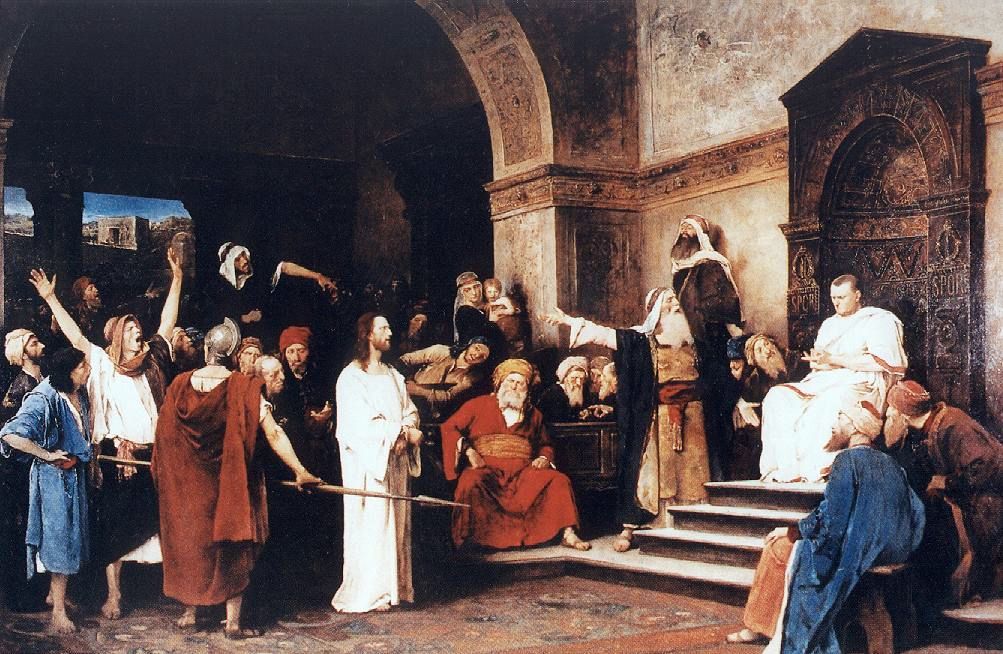
Christ in Front of Pilate, by Mihály Munkácsy (1881)

Many hymns have been written over the centuries extolling God's great love in sending his Son to suffer and die in our place so that we might live with Him forever.  But none bring home this awesome truth in a more concrete and personal way than My Song is Love Unknown. The text was written by Samuel Crossman (1623 -- 1683), an English clergyman (of whom no image is known to exist), and was first published in 1664 as a poem in his short book The Young Man’s Meditation, or Some Few Sacred Poems upon Select Subjects and Scriptures. Crossman was born in Suffolk, England, in 1623.  After earning a bachelor of divinity degree at Pembroke College, Cambridge, he ministered at first to both an Anglican and a separate Puritan congregation.Although he had strong Puritan sympathies, he was a non-separatist who tried to reconcile differences with the Anglican establishment. After the Church of England expelled Crossman and about 2,000 other ministers with similar sympathies in 1662, he renounced Puritanism, rejoined the Church, and became a royal chaplain in 1665. He moved to a post at Bristol Cathedral in 1667 and became its Dean in 1683, shortly before his death. He now lies buried beneath the south aisle of the cathedral.

Here is the exquisite text of Crossman's poem, which--reflecting on all the salient events of Holy Week and our Lord's Passion--poignantly expresses sorrow for sin and fervent love for the One who gave up His glory and His life that it might be forgiven:
My song is love unknown,
My Saviour’s love to me;
Love to the loveless shown,
That they might lovely be.
O who am I, that for my sake
My Lord should take frail flesh and die?

He came from His blest throne
Salvation to bestow;
But men made strange, and none
The longed-for Christ would know:
But O! my Friend, my Friend indeed,
Who at my need His life did spend.

Sometimes they strew His way,
And His sweet praises sing;
Resounding all the day
Hosannas to their King:
Then “Crucify!” is all their breath,
And for His death they thirst and cry.

Why, what hath my Lord done?
What makes this rage and spite?
He made the lame to run,
He gave the blind their sight,
Sweet injuries! Yet they at these
Themselves displease, and ’gainst Him rise.

They rise and needs will have
My dear Lord made away;
A murderer they save,
The Prince of life they slay,
Yet cheerful He to suffering goes,
That He His foes from thence might free.

In life, no house, no home
My Lord on earth might have;
In death no friendly tomb
But what a stranger gave.
What may I say? Heav’n was His home;
But mine the tomb wherein He lay.

Here might I stay and sing,
No story so divine;
Never was love, dear King!
Never was grief like Thine.
This is my Friend, in Whose sweet praise
I all my days could gladly spend.
It isn't altogether clear what Crossman meant by "love unknown"--love beyond comprehension, perhaps? Or love unknown and unappreciated by those to whom it's extended?  The first stanza itself may hold the answer: "Love to the loveless shown/That they might lovely be."  We are surely the "loveless," not returning love to Him who freely gave it, that we who were yet sinners might be spotless as He is. (Romans 5:8)

The Crucifixion of Jesus Christ
Note also the personal intimacy reflected throughout the hymn: "who am I, that for MY sake/MY Lord should take frail flesh and die?"  And in the second stanza: "O! MY Friend, MY Friend indeed,/Who at MY need His life did spend."  This theme of "friendship" with Jesus--a very personal relation indeed--is sounded throughout the hymn. (John 15:12-14)  So too is the believer's anguish at the way his "Friend" was first hailed and then betrayed, scorned, murdered, and abandoned by the very people He had come to heal and save--including the believer, who acknowledges that Christ's tomb was where he himself should have lain in death, but for his Savior's love. The hymn is closed by two of the simplest, sweetest lines ever penned: "This is my Friend, in Whose sweet praise/I all my days could gladly spend."

John Ireland
Crossman's poem has been set to a number of different tunes, but the one best-known and most often sung today was written by English composer John Ireland (1879 – 1962). Ireland is said to have composed the melody over lunch one day, within fifteen minutes on a scrap of paper, at the suggestion of organist and fellow-composer Geoffrey Shaw.  The tune, called Love Unknown (appropriately enough), was first published in 1919 in The Public School Hymn Book, of which Shaw was an editor.

[NOTE: Although the work is in the public domain in the USA, I have not been able to locate and reproduce here a copy of the sheet music to Ireland's tune.]


* * * * *
Here are three very different, but all very beautiful, renditions of this precious hymn. The first is a traditional arrangement sung by the Wells Cathedral Choir:


The next is a solo rendition by British singer and vocal coach Sylvia Burnside. This may be even a better way to sing this hymn, as a solo presentation accentuates its intensely personal, emotional nature, and the words are more easily understood.


The third rendition is another solo, by contemporary Christian singer/composer/arranger Fernando Ortega. This version apparently follows the tune Rhosymedre, by Welsh Anglican hymnist John David Edwards (1805 – 1885). It's almost as appealing as John Ireland's tune Love Unknown, but the latter seems--to my ear at least--to better fit the spirit of the text.


* * * * *
Never doubt God's love for YOU. You're as precious to Him as any and every other one of His children. Remember that Christ came to earth to save YOU, to pay for YOUR sins, no matter what they might be--and would have done so if even you were the only sinner who had ever lived. He loved YOU so much, that He went through all that He did just so He could have YOUR company in Heaven forever. There's never been a greater miracle. It truly is the Greatest Love Story Ever Told!

The Resurrection of Christ, by Jacopo Tintoretto

For I am persuaded, that neither death, nor life, nor angels, nor principalities, nor powers, nor things present, nor things to come, Nor height, nor depth, nor any other creature, shall be able to separate us from the love of God, which is in Christ Jesus our Lord . . .
      ~ Romans 8:38-39

Sunday, January 20, 2013

On Jordan’s Stormy Banks I Stand

Moses Viewing the Promised Land (1846),
by Frederic Edwin Church
Tyranny, terrorism, massacres, corruption, financial collapse, riots, wars, environmental disaster, hunger, disease, earthquakes and storms--the world seems engulfed in a wave of calamity. Individuals are everywhere beset with personal crises as well--family discord, divorce, unemployment, bankruptcy, homelessness. So many desperate people, knowing not where to turn, take their own lives or turn on their neighbors in helpless rage. Is there any hope for the world, or for ourselves?

Blinded by our modern expectations and distractions, we forget that such troubles have been the common plight of mankind since we appeared on this earth. Yet, people of the past seem to have coped better with the trials of life; they were at once more accepting of adversity, and met challenges with greater resolve and endurance, than most people do today. Whence came that inner strength, that reservoir of hope and confidence?

I think it was faith in God, and in His assurance of a happier world beyond this one. As is stated in the letter to the Hebrews, the faithful:
not having received the promises, but having seen them afar off, . . . were persuaded of them, and embraced them, and confessed that they were strangers and pilgrims on the earth. For they that say such things declare plainly that they seek a country. . . .  But now they desire a better country, that is, an heavenly: wherefore God is not ashamed to be called their God: for he hath prepared for them a city. (Heb. 11:13-16)
The believer's fervent longing to dwell in that city, that "better country," is often expressed in the hymns people wrote and sung in earlier, more spiritually "enlightened" times. A common theme, often appearing in the latter verses, is the joy of deliverance and perfect peace in the Lord's kingdom when our sorrowful sojourn here is over. In this theme death is not feared, but anticipated, as the doorway to eternal life and happiness--to "a treasure in the heavens that faileth not, where no thief approacheth, neither moth corrupteth. For where your treasure is, there will your heart be also." (Luke 12:33, 34)

A marvelous example of this attitude is the hymn On Jordan’s Stormy Banks I Stand, written by English Baptist minister Samuel Stennett (1727 – 1795), one of the most respected and influential preachers among the Dissenting or non-conformist groups of his time.The text of this hymn was first published in John Rippon’s 1787 Selection of Hymns, with the title “Heaven Anticipated.” The tune to which the hymn was first set, called "Promised Land," appeared in William Walker's 1835 Southern Harmony, and was attributed by Walker to Matilda Durham (1815 - 1901 (of whom no known image exists), a music teacher from Spartanburg County, South Carolina. Later, prominent Southern musician Rigdon McCoy McIntosh changed the tune from minor to major and added the refrain. The hymn was first published in its present form, in 1895, in a hymnal called The Gospel Light, edited by H. R. Chrisite.

Samuel Stennett
Rigdon M. McIntosh
Among the best known revival spirituals, this hymn was especially popular among 19th-century American Methodists, being sung in camp meetings and brush arbors, and is part of the American shape note tradition.

Below is the text to this delightful hymn, which points us to the true destiny of the believer and echoes the exultant cry of Paul in 1 Corinthians 15:55, "O death, where is thy sting? O grave, where is thy victory?"
On Jordan’s stormy banks I stand,
And cast a wishful eye
To Canaan’s fair and happy land,
Where my possessions lie.


Refrain
I am bound for the promised land,
I am bound for the promised land;
Oh who will come and go with me?
I am bound for the promised land.


O the transporting, rapturous scene,
That rises to my sight!
Sweet fields arrayed in living green,
And rivers of delight!
Refrain

There generous fruits that never fail,
On trees immortal grow;
There rocks and hills, and brooks and vales,
With milk and honey flow.
Refrain

O’er all those wide extended plains
Shines one eternal day;
There God the Son forever reigns,
And scatters night away.


Refrain

No chilling winds or poisonous breath
Can reach that healthful shore;
Sickness and sorrow, pain and death,
Are felt and feared no more.


Refrain

When I shall reach that happy place,
I’ll be forever blest,
For I shall see my Father’s face,
And in His bosom rest.


Refrain

Filled with delight my raptured soul
Would here no longer stay;
Though Jordan’s waves around me roll,
Fearless I’d launch away.


Refrain
What I so love about this hymn is its joyful and sure conviction of the deliverance to come. As another astute observer has noted, "anticipation has always been an important characteristic of God’s people. In the Old Testament, it was Israel’s anticipation of the promised land, Canaan. For the New Testament believer, it is the glorious hope of one day sharing eternity with our Savior and Lord Jesus Christ." (an excellent analysis of On Jordan's Stormy Banks as expressing the believer's "anticipation of heaven" can be found here)

The Jordan River today
Perfectly complementing the text is the happiness and pleasing rhythm of the music. I can't imagine a better thing to sing to lift one's spirits and get through some trial of life, great or small.

You'll see what I mean in the following video by Bill and Gloria Gaither and Friends--this is my favorite rendition of the hymn:


Bill & Gloria Gaither - On Jordan's Stormy... by Bill-Official

Following is a very different take on the hymn; while basically faithful to the original text and tune, it's sung here in a very creative, vocally impressive performance arrangement by the Brigham Young University (BYU) Singers:


* * * * *
No matter how difficult and challenging life becomes, remember that there is always hope, always light, always life at the end of the tunnel--if you have faith, there IS a beautiful, happy, eternal home prepared just for you, where our Lord awaits with open arms!


I go to prepare a place for you.
And if I go and prepare a place for you, I will come again,
and receive you unto myself;
that where I am, there ye may be also.
John 14:1-3

Saturday, December 22, 2012

O Holy Night (Cantique de Noël)


His law is love and His gospel is peace . . .

The Christmas season is the height of the year for sacred music and the singing of hymns. Among the most popular and oft-recorded is the one known in the English-speaking world as O Holy Night, and to French speakers as Cantique de Noël.  No other hymn captures the message of Christmas more beautifully or fully, and none has a more interesting history.
 
It all started in 1847, when Placide Cappeau (1808–1877), a wine merchant and occasional poet living in Roquemaure, France, was asked  by a parish priest to write a Christmas poem. Cappeau, though not a regular churchgoer, agreed to try.  On December 3, in a carriage about halfway to Paris where he was headed on a business trip, Cappeau was inspired to write the poem Minuit, Chrétiens (Midnight, Christians). When Cappeau arrived in Paris he took the poem to an acquaintance, the composer Adolphe Adam (1803-1856)--who had composed the music for the famous ballet Giselle in 1841--and asked him to set Minuit, Chrétiens to music.  Adam agreed and wrote the tune in a few days, and the resulting hymn Cantique de Noël received its premier at midnight Mass on Christmas Eve 1847, in Roquemaure.
 
Placide Cappeau
Adolphe Adam
The hymn soon became one of the most beloved hymns in France, and was incorporated into many Roman Catholic Christmas services. Incredibly, however, it was later denounced by the French church when Placide Cappeau abandoned Catholicism and became a socialist, and church leaders discovered that Adolphe Adam was of Jewish descent. One French bishop went so far as to criticize the hymn for its supposed "lack of musical taste and total absence of the spirit of religion." Nevertheless, Cantique de Noël remained popular among the French people.

John S. Dwight
By 1855, Cappeau's text had been translated into English by John Sullivan Dwight (1813–1893), a Unitarian minister and America's first influential classical music critic. Now titled O Holy Night, the hymn quickly found favor in this country, especially in the North during the American Civil War.

Reading Dwight's text, it's easy to see why people have been inspired by this hymn for more than 150 years: its affirmation of of hope and the promise of redemption; its celebration of the miracle of God come to earth and made man like us; and its declaration of a new kingdom of love, peace, and freedom for all God's children.

    O holy night! The stars are brightly shining,
    It is the night of our dear Saviour's birth.
    Long lay the world in sin and error pining,
    'Til He appear'd and the soul felt its worth.
    A thrill of hope the weary world rejoices,
    For yonder breaks a new and glorious morn.


        Fall on your knees! O hear the angel voices!
        O night divine, O night when Christ was born;
        O night divine, O night, O night Divine.


    Led by the light of Faith serenely beaming,
    With glowing hearts by His cradle we stand.
    So led by light of a star sweetly gleaming,
    Here come the wise men from Orient land.
    The King of Kings lay thus in lowly manger;
    In all our trials born to be our friend.


        He knows our need, to our weakness is no stranger,
        Behold your King! Before Him lowly bend!
        Behold your King, Before Him lowly bend!


    Truly He taught us to love one another;
    His law is love and His gospel is peace.
    Chains shall He break for the slave is our brother;
    And in His name all oppression shall cease.
    Sweet hymns of joy in grateful chorus raise we,
    Let all within us praise His holy name.


        Christ is the Lord! O praise His Name forever,
        His power and glory evermore proclaim.,
        His power and glory evermore proclaim.


It's interesting to note how Placide Cappeau's strongly abolitionist views, which were shared by John S. Dwight, are clearly expressed in the third and fourth lines of the hymn's final stanza.

There is a legend that on Christmas Eve in 1870, during the Franco-Prussian War, a French soldier suddenly jumped out of his trench and sang Cantique de Noël.  Moved by this brave gesture, the Germans did not fire upon the French soldier; instead, a German soldier emerged from his trench and sang Luther's Vom Himmel hoch da komm ich her (From Heaven Above To Earth I Come) a
popular Christmas hymn in his country.  According to the story, fighting stopped for the next 24 hours while the men on both sides observed a temporary peace in honor of Christmas Day.

Perhaps the most remarkable story about O Holy Night is one that is indisputably true: it was the second piece of music ever broadcast on radio, and the first musical performance ever broadcast live.  On Christmas Eve in 1906, Canadian-born inventor Reginald Aubrey Fessenden broadcast the first AM radio program, which started with Fessenden reading the Biblical account of the birth of Christ from Luke Chapter 2 over the air, followed by a phonograph recording of Handel's aria "Ombra mai fu," and concluding with Fessenden playing O Holy Night on the violin while singing the final verse.  Broadcast from Brant Rock, Massachusetts, the program was picked up by radio operators on board a number of ships along the Atlantic northeast coast and from shore stations as far south as Norfolk, Virginia.

From that humble beginning, O Holy Night has become one of the most treasured hymns of Christmas, the world over. Watch this video for an excellent summary of its history:


Here is a remarkably beautiful rendition of O Holy Night by the all-female Irish musical ensemble Celtic Woman:


The incomparable Nat King Cole recorded O Holy Night in 1960; this rendition is presented in the lovely video below:


HAVE A BLESSED AND JOYOUS CHRISTMAS!


And there were in the same country shepherds abiding in the field, keeping watch over their flock by night.  And, lo, the angel of the Lord came upon them, and the glory of the Lord
shone round about them: and they were sore afraid. And the angel said unto them, Fear not: for, behold, I bring you good tidings of great joy, which shall be to all people. For unto you
is born this day in the city of David a Saviour, which is Christ the Lord.
Luke 2:8-11

Saturday, November 10, 2012

Eternal Father, Strong to Save (Navy Hymn)


And, behold, there arose a great tempest in the sea, insomuch that the ship was covered with the waves: but he was asleep. And his disciples came to him, and awoke him, saying, Lord, save us: we perish. And he saith unto them, Why are ye fearful, O ye of little faith? Then he arose, and rebuked the winds and the sea; and there was a great calm. But the men marvelled, saying, What manner of man is this, that even the winds and the sea obey him! ~ Matt. 8:24-27

Sunday, November 11, is Veterans Day in the United States and Remembrance Day in Great Britain and the Commonwealth (click here for my 2011 post on observance of this day). Established in the 1920s to commemorate the signing of the Armistice on November 11, 1918 that ended World War I, Veterans Day has since been re-christened in the United States as an occasion to remember and honor all men and women who have served in the Armed Forces of the United States, from Revolutionary times to the present. Given how many of them made the ultimate sacrifice to preserve freedom for us all, and how close so many service members live to the edge of mortality, day in and out, the singing of hymns in their remembrance is most fitting.

John W. Fleming
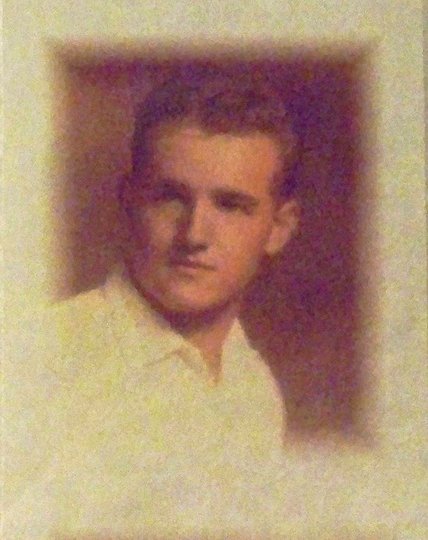
Veterans Day is special to me, in large part, because my father (at left, as a young man) is a veteran of the United States Navy (and, while he served as a Hospital Corpsman with occupation forces in 1950s Japan, of the United States Marine Corps).  He is very proud of his service, and so is everyone in our family! In his honor, I'd like to feature the hymn most closely associated with the Navy and sailors in general, Eternal Father, Strong to Save.

According to the Naval History and Heritage Command, the work known to United States Navy men and women as the "Navy Hymn" is a musical benediction long having a special appeal to seafarers, particularly in the American Navy and the Royal Navies of the British Commonwealth. The original text was written as a poem by a schoolmaster and clergyman of the Church of England, the Rev. William Whiting (1825-1878). He resided on the English coast near the sea and at the age of 35 survived a furious storm while on a voyage in the Mediterranean. Later, a student came to Whiting and confided to him an overwhelming fear of the ocean, which he had to cross in order to travel to America. Whiting told him of his experiences on the ocean, and assured him: "Before you depart, I will give you something to anchor your faith."

William Whiting
The compilers of Hymns Ancient and Modern revised the text when they included it in their first edition in 1861 to the form in which it is now known. Whiting himself rewrote the entire hymn in 1869, and it is this version which is found in most hymnals. Also in 1861, the text was adapted to music by another English clergyman, the Rev. John Bacchus Dykes (1823-1876), who originally wrote the music as "Melita," an ancient name for the Mediterranean island of Malta, where the Apostle Paul was supposedly shipwrecked. Rev. Dykes composed the music to many other well-known hymns, including Lead, Kindly Light; Holy, Holy, Holy; Jesus, Lover of My Soul; and Nearer, My God to Thee.
John B. Dykes

Whiting's text presents us with an eloquent expression of man's frailty before God and the power of His Creation, and with a moving prayer for His continued mercy and loving protection. Dykes' music is like the sea itself, rising and falling; brooding, ascending, and finally coming to rest. No wonder it has been the sailor's favorite for more than 150 years!
Eternal Father, strong to save,
Whose arm hath bound the restless wave,
Who bidd'st the mighty ocean deep
Its own appointed limits keep;
Oh, hear us when we cry to Thee,
For those in peril on the sea!

O Christ! Whose voice the waters heard
And hushed their raging at Thy word,
Who walkedst on the foaming deep,
And calm amidst its rage didst sleep;
Oh, hear us when we cry to Thee,
For those in peril on the sea!   

Most Holy Spirit! Who didst brood
Upon the chaos dark and rude,
And bid its angry tumult cease,
And give, for wild confusion, peace;
Oh, hear us when we cry to Thee,
For those in peril on the sea!

O Trinity of love and power!
Our brethren shield in danger's hour;
From rock and tempest, fire and foe,
Protect them wheresoe'er they go;
Thus evermore shall rise to Thee
Glad hymns of praise from land and sea.

Eternal Father, Strong to Save has had an interesting history since its first publication. In 1879 Lt. Comdr. Charles Jackson Train, an 1865 graduate of the United States Naval Academy who went on to become a Rear Admiral, was stationed at the Academy in charge of the Midshipman Choir. In that year Train inaugurated the tradition, still observed, of concluding each Sunday's Divine Services at the Academy with the singing of the first verse of this hymn.

Winston Churchill requested the singing of Eternal Father, Strong to Save at a church service aboard the Royal Navy battleship HMS Prince of Wales during his 1941 conference with President Franklin D. Roosevelt for creation of the Atlantic Charter. Ironically, this was also the last hymn sung during the Sunday, April 14, 1912 church service aboard the RMS Titanic just hours before it sank. It was sung at the funeral of President Roosevelt (who had previously served as Secretary of the Navy); played by the Navy Band at the funeral of President John F. Kennedy, a World War II PT-boat commander; sung at the funeral of former President Richard Nixon; and played by the Navy and Coast Guard Bands during the funeral of the late President Ronald Reagan. The hymn was performed by the U.S. Navy Sea Chanters   at the funeral of President Gerald R. Ford, who had served in the Navy during World War II in the Pacific Theater. This was also the final hymn sung at the 2011 funeral in Australia of Claude Choules, the last living seaman and combat veteran of World War I.

Eternal Father, Strong to Save, and variants of it for every branch of service from submariners, Marines, Seabees, and airmen to Coast Guardsmen, nurses, astronauts, and even Arctic explorers, has been performed in such popular films as Crimson Tide, The Right Stuff, The Perfect Storm, and Titanic.

*****
The video below features a congregation singing Eternal Father, Strong to Save with moving scenes of seamen, ships, crashing waves, and cathedral windows memorializing the sea service:


This presentation is by the Naval Academy Men's Glee Club in a 2008 visit to San Antonio, Texas:


There are many times in life when we feel utterly helpless and in peril of our lives, at the mercy of dark, raging forces we cannot stem. We call upon God to save us, as He is the only One with power and love enough to move all Creation to protect us from destruction. Give joyful thanks and praise always that we can trust always in the arms of such a faithful Lord!


They that go down to the sea in ships, that do business in great waters; these see the works of the Lord, and his wonders in the deep. For he commandeth, and raiseth the stormy wind, which lifteth up the waves thereof. They mount up to the heaven, they go down again to the depths: their soul is melted because of trouble. They reel to and fro, and stagger like a drunken man, and are at their wit's end. Then they cry unto the Lord in their trouble, and he bringeth them out of their distresses. He maketh the storm a calm, so that the waves thereof are still. Then are they glad because they be quiet; so he bringeth them unto their desired haven. ~ Psalm 107:23-30