Showing posts with label Fernando Ortega. Show all posts

Thursday, April 10, 2014

When I Survey the Wondrous Cross

Christ on the Cross, Eugene Delacroix (1853)

For the preaching of the cross is to them that perish foolishness; but unto us which are saved it is the power of God. 
 ~ 1 Corinthians 1:18     

Christ's atonement on the Cross for the sins of mankind, fulfilled with His resurrection from the dead and ascension into Heaven, is the central and most decisive moment in all history.  Beside it pale any human accomplishment, no matter how great and glorious. In that one event justice and mercy were fully and eternally satisfied, and all creation was reconciled to its Creator. We can never fully comprehend, in this life, the magnitude of Christ's burden and suffering, or of the love it took to endure and overcome it for our sakes.

Isaac Watts

The great English theologian and hymnist Isaac Watts (1674-1748) must have been reflecting along these lines when, in preparation for a communion service, he wrote the text that later became the immortal hymn When I Survey the Wondrous Cross. The work was originally called "Crucifixion to the World by the Cross of Christ," following the practice of the day to summarize a hymn's theme in the title. It was first published in 1707 in Watts' collection Hymns and Spiritual Songs, and was inspired by Galatians 6:14: "But God forbid that I should glory, save in the cross of our Lord Jesus Christ, by whom the world is crucified unto me, and I unto the world."

This hymn is significant as an innovative departure from the prevailing English practice of the day to sing only paraphrased biblical texts and metrical psalms. It was also one of the first English-language hymns to use the personal pronoun "I", and thus to focus on personal religious experience rather than abstract doctrine. In Isaac Watts' time these were called "hymns of human composure," and were very controversial. Thus, When I Survey holds an important place in the history of sacred music, and went far to establish Watts' reputation as "the Father of English Hymnody."

In 1757, the famous English evangelist George Whitefield (1714-1770) included When I Survey in the Supplement to his popular Collection of Hymns for Social Worship.The next year, When I Survey first appeared in a hymnal published in the United States,The Psalms, Hymns and Spiritual Songs of the Old and New Testament (1758). Since then, it has been found in the hymnals of American denominations as varied as traditional Protestants, Roman Catholics, Mormons, Unitarians and the Assemblies of God.

THE TEXT

In its first publication in 1707, When I Survey had five stanzas, as below, but in an enlarged edition of Hymns and Spiritual Songs in 1709, Watts bracketed the fourth stanza for optional use.
When I survey the wondrous cross
On which the Prince of Glory died,
My richest gain I count but loss,
And pour contempt on all my pride.

Forbid it, Lord, that I should boast,
Save in the death of Christ my God,
All the vain things that charm me most,
I sacrifice them to His blood.

See from His head, His hands, His feet,
Sorrow and love flow mingled down,
Did e'er such love and sorrow meet,
Or thorns compose so rich a crown?

His dying crimson, like a robe,
Spreads o'er His body on the tree;
Then I am dead to all the globe,
And all the globe is dead to me.

Were the whole realm of nature mine,
That were a present far too small;
Love so amazing, so divine,
Demands my soul, my life, my all.
 THE MUSIC

Edward Miller
When I Survey the Wondrous Cross has been set to several different tunes over the years. The hymn's inclusion in the milestone English hymnal Hymns Ancient and Modern (1861) sealed its association in British usage to the tune ROCKINGHAM, which was arranged by English organist and composer Edward Miller (1735-1807) and first published in 1790. As a young man Miller was apprenticed to his father, a layer of paving stones, but ran away to study music. At one time he was a flutist in Georg F. Handel’s orchestra. Miller named ROCKINGHAM for his friend, patron, and twice-British Prime Minister Charles Watson-Wentworth, the 2nd Marquess of Rockingham. ROCKINGHAM has been called "one of the finest long-meter tunes in the history of church music."


Lowelll Mason
In American hymnals, When I Survey is generally set to an arrangement of HAMBURG, a tune composed by the prominent 19th-century American music director, choirmaster, and organist Lowell Mason (1792-1872), and first published in the Boston Handel and Haydn Society Collection of Church Music (3d ed.) in 1825. Mason was largely responsible for introducing music into American public schools, and is considered to be the first important music educator in the United States. He also radically transformed American church music from a practice of having professional choirs and accompaniment to congregational singing accompanied by organ music. Mason stated that he arranged HAMBURG from an ancient Gregorian chant. The entire melody encompasses only a five-note range.


Another oft-heard tune associated with When I Survey is MORTE CHRISTE, attributed to Welshman Emrys Jones. This tune is especially popular with male voice choirs in the United Kingdom, and particularly Wales. Unfortunately, this writer hasn't been able to locate sheet music for this tune.

RENDITIONS

The following rendition of When I Survey is by the Choir of King's College, Cambridge to Edward Miller's tune ROCKINGHAM.


This rendition is to Lowell Mason's tune HAMBURG (though at a slower pace than originally composed), by the contemporary Christian artist Fernando Ortega:


Click here for another fine rendition to the tune HAMBURG, as arranged by Gilbert M. Martin, by the Mormon Tabernacle Choir.

In the following rendition, the Welsh choir Cantorion Colin Jones sings When I Survey to Emrys Jones' tune MORTE CHRISTE:


And now for something completely different:  A performance of When I Survey set to the old folk tune The Water is Wide (also called "O Waly,Waly") and performed by Christian songwriter and worship leader Kathryn Scott. In this writer's humble opinion, this tune is at least as effective in conveying the message of Watts' text as the more traditional settings, if not more so!


LEGACY AND REFLECTION

Is Isaac Watts' When I Survey the Wondrous Cross the greatest hymn ever written? Many believe that distinction belongs to Charles Wesley's Jesus, Lover of My Soul, the subject of our last post. But Wesley himself stated that he preferred When I Survey over all of the hymns he himself had written. The great Victorian essayist and poet Matthew Arnold considered it the “finest hymn in the English church.”  As the story goes, Arnold heard the hymn sung at a Presbyterian church in Liverpool, England on the last Sunday of his life, and was overheard repeating the third verse shortly before his sudden death a few days later.

When I Survey the Wondrous Cross remains one of the most popular hymns in English-speaking Christendom. It placed among the top five in the United Kingdom in surveys of the public taken in the 1990s.  (Ian Bradley, Abide With Me: The World of Victorian Hymns (GIA Publications, 1997), p. 231). It was one of the first hymns sung at Billy Graham’s first crusade in Los Angeles, California, in 1949. Tedd Smith, one of the pianists with the Graham Crusades, said about this hymn:
It seems to me that Isaac Watts wrote this text as if he were standing at the foot of Christ’s cross, together with the disciple John, the faithful women, Jesus’ mother, the Roman soldiers and the excited mob. When I play or sing the hymn, I try to make Watts’ ideas and words my own. With him, I cannot help but marvel at the incredulity of the scene—the “Prince of heaven” nailed to a tree by sinful men. Jesus, dying for me! For it was my sins which He bore on that terrible day.
(Crusade Hymn Stories, edited by Cliff Barrows, Hope Publishing Co., Chicago, 1967)

Here is an excellent video review of the history and significance of Watts' signature hymn:


* * * * *

The simplest expressions, when moved by truth and passion, are always the most powerful. In its 16 brief lines, When I Survey the Wondrous Cross  "paints a soul-stirring picture of the Saviour's death on the cross coupled with the whole-hearted response of the believer to such amazing love."  Watts' eloquent words reflect the awe of knowledge that nothing within the accomplishment of any man can even begin to compare to what Christ did for each and all of us, the perfectly innocent for the utterly guilty, on the Cross. We can hardly understand the depth and magnitude of the love it took to accomplish our salvation; we can only give ceaseless thanks for it, and try to emulate it in our own lives. Truly, as was said to the Galatians (Gal. 6:14), the only just cause for glory is in the cross of our Lord Jesus Christ.


Monday, February 17, 2014

Jesus, Lover of My Soul


[W]hen he saw the wind boisterous, he was afraid; and beginning to sink, he cried, saying, Lord, save me. And immediately Jesus stretched forth his hand, and caught him, and said unto him,
O thou of little faith, wherefore didst thou doubt? ~ Matthew 14:30-31

With the recent Valentine's Day observance here in the United States, we've heard much talk (especially from sellers of flowers and candy) about "love" and "lovers."  Of course, it's the romantic sort of love that people have in mind. What many forget or fail to appreciate, however, is a kind of love that has nothing to do with attractiveness or favorites, material generosity or even mere affection. This is the love that brought the universe and every person into being, that gives everything and endlessly without condition or seeking for itself, that pursues us like no human lover ever would, and that, like no human lover's, will ever flag or fail. That, of course, is God's love for each one of us.

In a modern world dominated by the works and wants of man--especially where material goods and comforts are plenty--we lose sight of how much we need God's love, and how empty and hopeless we would be without it. When times are good, we grow smugly self-confident and feel that we need no God, or even that He doesn't really exist. Yet, when things change for the worse and we can't cope, we instinctively turn to Him for rescue. Our relationship with the Heavenly Father is thus much like that between a young adult and his or her parent: the "new grownup" strides into the world confidently, believing that the parent's guidance and support are no longer needed. But when the strength of youth has been spent, the "prodigal son" flees home to the patient, loving parent, who forgives all and once more showers the child with blessings. This relationship is beautifully expressed in what some have called the finest hymn in the English language: Jesus, Lover of My Soul (sometimes also titled "Jesu, Lover of My Soul").

THE TEXT

Charles Wesley
The text of this immortal hymn was written by the great English evangelist Charles Wesley (1707-1788), and was first published in his collection Hymns and Sacred Poems in 1740 (it was originally titled “In Time of Prayer and Temptation”). This hymn has as its theme the sufficiency of Christ to give comfort, power, and grace in any circumstance. In five compact stanzas, Wesley captures the essential nature of our flawed and and helpless human condition and our dependence on the grace and mercy of the Savior for salvation. He expresses that relationship by contrasting stormy seas and safe havens, defenselessness and protection, need and succor, sickness and healing, sin and and redemption:
Jesus, Lover of my soul,
let me to thy bosom fly,
while the nearer waters roll,
while the tempest still is high:
hide me, O my Savior, hide,
till the storm of life be past;
safe into the haven guide,
O receive my soul at last.

Other refuge have I none,
hangs my helpless soul on thee;
leave, ah! leave me not alone,
still support and comfort me!
All my trust on thee is stayed;
all my help from thee I bring;
cover my defenseless head
with the shadow of thy wing.

Wilt Thou not regard my call?
Wilt Thou not accept my prayer?
Lo! I sink, I faint, I fall—
Lo! on Thee I cast my care.
Reach me out Thy gracious hand!
While I of Thy strength receive,
Hoping against hope I stand,
Dying, and behold, I live.

Thou, O Christ, art all I want;
mor than all in thee I find;
raise the fallen, cheer the faint,
heal the sick, and lead the blind.
Just and holy is thy Name;
I am all unrighteousness;
false and full of sin I am;
thou art full of truth and grace.

Plenteous grace with thee is found,
grace to cover all my sin;
let the healing streams abound,
make and keep me pure within.
Thou of life the fountain art,
freely let me take of thee:
spring thou up within my heart,
rise to all eternity.
Of Wesley's thousands of hymns, Jesus, Lover of My Soul is generally considered to be his finest. The distinguished American preacher, Henry Ward Beecher (1813-1887), acclaimed the hymn's greatness when he wrote:
I would rather have written that hymn of Wesley’s than to have the fame of all the kings that ever sat on the earth. It is more glorious. It has more power in it. I would rather be the author of that hymn than to hold the wealth of the richest man in New York. He will die. He is dead, and does not know it . . . But that hymn will go singing until the last trump brings forth the angel band; and then, I think, it will mount up on some lip to the very presence of God.
Dr. George Duffield (1818-1888), author of Stand Up, Stand Up for Jesus, similarly wrote that "If there is anything in Christian experience of joy and sorrow, of affliction and prosperity, of life and death, that hymn is the hymn of the ages!"

Many other anecdotes relate how beloved is Jesus, Lover of My Soul, and of its transformative power. Among the most heartwarming is one that purportedly occurred during the American Civil War:
[T]he opposing armies of the Federals and Confederates on a certain occasion, were facing each other. One night a Confederate sentry was on duty when he heard the sound of singing coming from the Federal lines. He proceeded cautiously in their direction, and observed an enemy sentry pacing up and down, singing "Jesu, Lover of my soul". Bringing his gun to his shoulder, he was about to shoot, when the singer came to the words, "Cover my defenceless head With the shadow of Thy wing". This was too much for the Confederate and he lowered his weapon and allowed his would-be victim to go unharmed. Many years passed, and the Confederate, now a private gentleman, was aboard an excursion steamer on the Potomac River, when he heard an evangelist singing this hymn. Memories were aroused, and thinking he recognised the voice, he made his way to the singer and in conversation found that the evangelist was indeed the sentry he had nearly shot. Great was their mutual joy when he revealed to the singer the peril from which he had been saved in that night long ago, when on sentry duty he besought divine protection by singing, "Jesu, Lover of my soul".
Given these accolades, it is interesting to note that when Charles Wesley first presented this hymn to his brother John, the founder of Methodism, he rejected it on the ground that it was "too sentimental" or "too pietistic and . . . intimate for public worship"!

Several accounts or theories about the circumstances in which Jesus, Lover of My Soul was written have been advanced, none of them authenticated. One is that it was written at some point after Charles Wesley's return to England in the fall of 1736, after a brief and disappointing sojourn in the American colonies. Wesley's ship was caught in a severe storm at sea and it appeared certain that she would go down with all hands. But on December 3 the ship reached port, and Wesley noted in his journal for that date that "I knelt down and blessed the hand that had conducted me through such inextricable mazes."  Others suggest that Wesley was inspired to write the hymn when, during this storm or on some other occasion, a frightened bird flew into his room and sheltered in his bosom for comfort and safety. A popular account, promoted by American evangelist Ira Sankey (1840-1908), is that Wesley wrote the hymn while hiding under a hedge on a farm in County Down, Ireland while being pursued by an angry mob that opposed his Methodist ministry--an interesting mental picture, except that, so far as is known, Charles Wesley never visited northern Ireland! (See Kenneth W. Osbeck, 101 Hymn Stories (Kregel Publications, 1982), p. 130).

THE MUSIC

The history of the hymn's music is as rich as that of its text.

Over the years, Jesus, Lover of My Soul has been paired with several different tunes. In the United States, the hymn first became popularly associated with the tune MARTYN, composed by American choir director and singing-school teacher Simeon Butler Marsh (1798-1875) (of whom no image is available). In 1834, Marsh was making his weekly round of singing schools between Amsterdam and Johnston, New York, when he wrote this tune, intending for it to be sung with John Newton’s hymn Mary to Her Savior’s Tomb.Because of this association, the melody is sometimes listed in hymnals as the "Resurrection Tune."  It was published in 1836 with Newton’s text in the first volume of Musical Miscellany, a collection by American hymn composer Thomas Hastings (1784-1872). MARTYN was first paired with Jesus, Lover of My Soul in 1851 in Darius E. Jones’s Temple Melodies. Some years after that, Hastings too discovered that MARTYN was well-suited for Wesley's text, and he began using it with great response in his new publications.

Somewhat unfairly, perhaps, MARTYN has been characterized as "a bland and repetitious tune . . . with a range of just a sixth. It does not seem to capture any of the restlessness of flying or tempests referenced in the text but rather to provide the safe haven that the singer seeks in Jesus." (See Music and the Wesleys, edited by Nicholas Temperley, Stephen Banfield, University of Illinois Press (2010), p. 81).

Jesus, Lover of My Soul has also been widely sung in the United States to the tune REFUGE, composed in 1862 by Joseph Perry Holbrook (1822-1888) (also of whom we have no image), an American musician whose other hymn tunes are little used today. REFUGE is the tune paired with Wesley's text in the current edition of the LDS (Mormon) Hymbook.

Joseph Parry
But today, in Great Britain and just about everywhere else, Jesus, Lover of My Soul is most popularly sung to the tune ABERYSTWYTH. It was written in 1876 by Welsh composer and musician Joseph Parry (1841-1903) and first published in 1879 in Edward Stephen's Ail Lyfr Tonau Ac Emynau (Welsh for "The Second Book of Tunes and Hymns"). Parry was at the time the first professor and head of the new department of music at University College Wales, Aberystwyth, now called Aberystwyth University, and so the tune is named after the Welsh coastal resort town in which Parry then lived. The D minor key and steady rhythm of this compelling tune perfectly reflect the plaintive, urgent spirit of Wesley's text.


Here is the text of Jesus, Lover of My Soul set to Parry's ABERYSTWYTH:


Below is Wesley's text set to Marsh's MARTYN:


And here is the hymn set to Holbrook's REFUGE:


RENDITIONS

While Jesus, Lover of My Soul is a beautiful and powerful hymn sung solo, congregationally, or by a choir, its first-person expression is ideally suited to a solo performance. Here is an excellent one, to the tune ABERYSTWYTH, by Christian singer, composer, and worship leader Fernando Ortega. All stanzas are sung, and Ortega's voice, as well as the spare piano/cello accompaniment, perfectly capture the spirit of the hymn.


Click here for an excellent rendition by an unidentified congregation (perhaps from the British Christian music program Songs of Praise?), also to the tune ABERYSTWYTH. Uunfortunately, the embedding feature has been disabled, so the video can't be played directly in this page.

The hymn as sung to the tune MARTYN may be somewhat less compelling, but is beautiful and endearing nonetheless. Here is a rendition by an unidentified--Mennonite?--congregation in a community sing:


The following rendition of the hymn is to Holbrook's tune REFUGE, performed by the Altar of Praise Chorale:


There are several contemporary arrangements of Jesus, Lover of My Soul, but by far the best is the one below by Christian artist Chris Eaton. His music is very heartfelt and, like ABERYSTWYTH, conveys the hymn's sense of urgency.


* * * * *
 For thou hast been a strength to the poor, a strength to the needy in his distress, a refuge from the storm, a shadow from the heat, when the blast of the terrible ones is as a storm against the wall.


Tuesday, November 26, 2013

Great is Thy Faithfulness


On November 28, here in the United States, we'll be celebrating Thanksgiving Day. This event was instituted nationwide in 1863 by President Abraham Lincoln, who proclaimed it a day of "Thanksgiving and Praise to our beneficent Father who dwelleth in the Heavens."  Traditionally, the holiday is typified by the gathering of families and and friends around a dinner table heaped with fruits of the harvest, and the recitation of good things which the participants are thankful to have. But do we think beyond the good things or "blessings" we have, and reflect sufficiently on where they came from and why we have them?

In this context, a "blessing" is not just a desirable state of affairs or a beneficial thing or event that fell to us by chance. Rather, it has been defined in various dictionaries as "the bestowal of a divine gift or favour" and as "a favor or gift bestowed by God, thereby bringing happiness."  Thus, the ultimate source of the benefit--our Father in Heaven--is just as important as the thing itself. Otherwise, getting it is just "good luck."  Moreover, blessings are a gift, and not just a reward for good behavior. Scripture tells us that "a faithful man shall abound with blessings" (Proverbs 28:20), and surely a steady faith in God and obedience to His Commandments will bring those spiritual and familial benefits that the Commandments were intended to secure to us, if not all the worldly benefits men desire. But if you think about it even for a moment, you should realize that you're blessed far beyond anything you could possibly earn or deserve, no matter how "good"--or bad--you are. If you don't feel very blessed, perhaps it's because you haven't thought about this very much, or at all.

So, WHY does our Heavenly Father bless us so abundantly, and freely?  I submit that it's simply because, as John says, God is Love (John 4:8). Like any good parent, His love is unconditional and beyond measure, and He wants nothing so much as our happiness. This is the core of His nature, and the way He always is. This commitment, this determination, is so great that He sent His only begotten Son into this world to ransom us from sin and death with His own blood, His own death--while we were yet sinners (Romans 5:8)--so that we could know eternal happiness with Him. This is the greatest gift of all!

Moreover, God's love and provision for us never fail; we can count on them absolutely. As the Bible puts it, He is ever "faithful" in blessing us:
Know therefore that the Lord thy God, he is God, the faithful God, which keepeth covenant and mercy with them that love him and keep his commandments to a thousand generations . . . (Deuteronomy 7:9)

It is of the Lord's mercies that we are not consumed, because his compassions fail not. They are new every morning: great is thy faithfulness. (Lamentations 3:22-23)

But the Lord is faithful, who shall stablish you, and keep you from evil. (2 Thessalonians 3:3)
Thomas O. Chisholm
One of the most moving celebrations of God's absolutely faithful love for us is the beautiful hymn Great is Thy Faithfulness.The text was written in 1923 by Thomas Obadiah Chisholm (1866-1960). He was born in Franklin, Kentucky on July 29, 1866, little more than a year after the end of the American CIvil War, in a log cabin. He attended a small country school and became its teacher at the age of only 16. At age 21, he became associate editor of Franklin's weekly newspaper. In 1893, at the age of 27, he accepted Christ as his Savior during a revival in Franklin led by Methodist evangelist Dr. Henry Clay Morrison. Chisholm later moved to Louisville, Kentucky at Morrison's request and became editor of the widely read Pentecostal Herald, and was himself ordained a Methodist minister in 1903 at the age of 36. He served a pastorate in Scottsville, Kentucky, but had to resign after one dear due to poor health. After moving his family to a farm near Winona Lake, Indiana (also home of the famous preacher Billy Sunday and, until 1990, headquarters of the Free Methodist Church), he became an insurance salesman. In 1916, at the age of 50, he moved his family again, this time to Vineland, New Jersey. He finally retired in 1953, when 87 years old, and passed away in February 1960 at the age of 93.

Chisholm had a hard adult life. His health was fragile and he was sometimes confined to bed, unable to work. Between illnesses he put in extra hours at various jobs in order to make ends meet. Nevertheless, he found great comfort in the Scriptures, and in the fact that God was faithful to be his strength in time of sickness and to provide for his needs. One of his favorite Bible passages was Lamentations 3:22-23: "It is of the Lord's mercies that we are not consumed, because His compassions fail not. They are new every morning: great is Thy faithfulness.”

William M. Runyan
In addition to selling insurance, and despite poor health, Chisholm wrote during his lifetime more than 1,200 poems and hymns (including among the latter O To Be Like Thee and Living for Jesus).  He also often wrote to friends, among them fellow Methodist minister and composer William Marion Runyan (1870-1957) in Kansas, who was affiliated with both the Moody Bible Institute and Hope Publishing Company. Chisholm sent Runyan several of his poems with these letters, including the text of Great is Thy Faithfulness. Runyan found it so moving that he decided to set it to music, and the hymn was published in 1923.

For some years thereafter the hymn received little recognition, until it was discovered by Moody professor William Henry Houghton, who loved it so much and requested it sung so often at chapel services, that the hymn became the unofficial theme song of the Institute. It was not until 1945, however, when George Beverly Shea began singing Great is Thy Faithfulness at the Billy Graham evangelistic crusades, that the hymn was heard around the world. Despite its eventual popularity, Thomas Chis­holm wrote that were no spe­cial cir­cum­stanc­es which caused the hymn's writ­ing—just his ex­per­i­ence and Bi­ble truth.
Great is Thy faithfulness, O God my Father;
There is no shadow of turning with Thee,
Thou changest not, Thy compassions they fail not,
As Thou hast been,Thou forever wilt be.
Refrain:
Great is Thy faithfulness!
Morning by morning new mercies I see
All I have needed Thy hand hath provided
Great is Thy faithfulness, Lord unto me!

Summer and winter and springtime and harvest,
Sun, moon, and stars in their courses above;
Join with all nature in manifold witness,
To Thy great faithfulness, mercy, and love.
(Refrain)

Pardon for sin and a peace that endureth,
Thine own great presence to cheer and to guide;
Strength for today, and bright hope for tomorrow
Blessings all mine, with ten thousand beside.
(Refrain)


The best reflection on this great hymn that I've read observes as follows:
Verse 1 speaks of God’s faithfulness revealed  in his Word, and is adapted from James 1:17:  "Every good gift and every perfect gift is from above, and cometh down from the Father of lights, with whom is no variableness, neither shadow of turning."

Verse 2 tells us of God’s faithfulness revealed in creation. The seasons, the sun, moon, and stars all continue on their courses perfectly, orderly, quietly – guided by God’s faithful hand, without any help from us.

Verse 3 reminds us of God’s faithfulness revealed in our lives. He pardons all our sins, fills us with his peace, assures of his presence, gives us strength, hope, and blessings to numerous to count!
VIDEO PRESENTATIONS

Great is Thy Faithfulness is marvelous to hear sung by a large congregation, making the rafters ring with their happy, exultant praise of our Lord for His ever-faithful goodness to us. Here's just such a presentation, by the congregation of Southwark Cathedral in London, England:


Click here for a lovely small group performance by the Blue Rock Mennonite Youth.

Great is Thy Faithfulness also lends itself well to solo performance, in a spirit of quiet, humble gratitude. Here is such a rendition, highlighted with stunning scenes of nature, by contemporary Christian artist Chris Rice:


Another Christian artist, Fernando Ortega, is known for new arrangements of traditional hymns and gospel songs that are very appealing, as well as faithful to the spirit of the original works. Here is his version of Great is Thy Faithfulness:


*******

As you give thanks for abundant blessings this holiday--or at any time--reflect not just on the things and advantages you enjoy, but especially on the One who lovingly bestowed them on you, and who blesses you beyond all deserving. Remember that His goodness goes hand-in-hand with His faithfulness, so that you may know that blessed assurance of a place with Him in eternal peace and happiness!


Friday, March 29, 2013

How Deep the Father's Love for Us

The Crucifixion (1622) by Simon Vouet

Surely he hath borne our griefs, and carried our sorrows: yet we did esteem him stricken, smitten of God, and afflicted. But he was wounded for our transgressions, he was bruised for our iniquities: the chastisement of our peace was upon him; and with his stripes we are healed. ~ Isaiah 53:4-5
     
Holy Week, beginning with Palm Sunday and culminating in Holy Thursday, Good Friday, and Easter Sunday, is the climax of the Christian year.  In this one short period are celebrated (among other events) Christ's triumphal entry into Jerusalem; the Last Supper; the Agony in the Garden of Gethsemane; Christ's arrest, trial, crucifixion, and death in atonement for our sins; and His resurrection from the dead on the third day thereafter. These events fulfilled divine promises and the visions of prophets declared many centuries before they actually happened. Nothing else written or imagined by man is so compelling a story; no other event in history is as important. It fixed the purpose of life and the destiny of man, the Earth, and all Creation.

The atonement, death, and resurrection of Jesus have inspired countless works of art, poetry, and music down through the centuries. The vastness of the subject might seem to make futile any attempt to capture it in a single work. But its essence, for man, is breathtakingly simple. As summed up in one popular hymn published in 1891, "I need no other argument, I need no other plea; It is enough that Jesus died, and that He died for me." (My Faith Has Found a Resting Place, by Eliza E. Hewitt).

And composers continue celebrating that simple, powerful message today.  Among the best examples is a song by Stuart Townend, an English Christian worship leader and writer of hymns and contemporary worship music. It's called How Deep the Father's Love for Us. This simple, three-stanza work embraces the salient events and greatest truths of Christ's passion, death on the Cross, and resurrection--especially, our redemption through them. The tune is likewise simple and graceful, and easy to sing--very much as with Christendom's most beloved traditional hymns.
How deep the Father’s love for us,
How vast beyond all measure,
That He should give His only Son
To make a wretch His treasure.
How great the pain of searing loss -
The Father turns His face away,
As wounds which mar the Chosen One
Bring many sons to glory.

Behold the man upon a cross,
My sin upon His shoulders;
Ashamed, I hear my mocking voice
Call out among the scoffers.
It was my sin that held Him there
Until it was accomplished;
His dying breath has brought me life -
I know that it is finished.

I will not boast in anything,
No gifts, no power, no wisdom;
But I will boast in Jesus Christ,
His death and resurrection.
Why should I gain from His reward?
I cannot give an answer;
But this I know with all my heart -
His wounds have paid my ransom.

How Deep the Father's Love for Us is very similar in theme and approach to My Song is Love Unknown, which was featured here a few weeks ago. Both hymns reflect the singer's sense of unworthiness and remorse, and of personal responsibility for the sin that brought about Jesus' suffering and death ("My sin upon His shoulders" . . . ", "It was my sin that held Him there"). The line referring to the singer's hearing his own "mocking voice/call out among the scoffers" brings powerfully home our own guilt, and brings stark immediacy to that awful scene of mob vengeance in Jerusalem almost 2000 years ago.

Another telling theme in this hymn is the unfathomable love of a Father who would sacrifice His only son to save someone who in no way deserved or had earned such a blessing, and the unutterable loneliness that Jesus must have endured as His Father "turned His face away" as His wounds earned salvation for all of us.

The third stanza of Townend's hymn testifies movingly to the redemptive, transforming power of Christ's sacrifice: "this I know with all my heart--His wounds have paid my ransom". It is a very anthem of that "blessed assurance" that the believer knows!  The precious work that secured it for us, and the glory rightfully attending it, are Christ's alone.

The Scripture student may notice is how this hymn echoes the main themes of Isaiah 53, in which Jesus' suffering and death in atonement for our sins was prophesied more than 700 years before it occurred.
He is despised and rejected of men; a man of sorrows, and acquainted with grief: and we hid as it were our faces from him; he was despised, and we esteemed him not.
Surely he hath borne our griefs, and carried our sorrows: yet we did esteem him stricken, smitten of God, and afflicted.
But he was wounded for our transgressions, he was bruised for our iniquities: the chastisement of our peace was upon him; and with his stripes we are healed.
All we like sheep have gone astray; we have turned every one to his own way; and the Lord hath laid on him the iniquity of us all.He was oppressed, and he was afflicted, yet he opened not his mouth: he is brought as a lamb to the slaughter, and as a sheep before her shearers is dumb, so he openeth not his mouth.
. . . [By] his knowledge shall my righteous servant justify many; for he shall bear their iniquities.
Therefore will I divide him a portion with the great, and he shall divide the spoil with the strong; because he hath poured out his soul unto death: and he was numbered with the transgressors; and he bare the sin of many, and made intercession for the transgressors.
It's rare indeed to be able to hear from a composer's own lips how he came to write a hymn, but here is a short interview with Stuart Townend himself about the spiritual and musical processes behind How Deep the Father's Love for Us:

[NOTE: If you subscribe to these posts by email, the videos may not appear; in that case you can see them at the Songs of Praises web site.]


* * * * *
Although How Deep the Father's Love for Us has now been published in at least eight hymnals, including the Baptist Hymnal and the hymnal used by the Church of Ireland, there seem to be no videos currently available featuring the hymn being such in a congregational setting. But there are several good solo and small group renditions, especially this one by Stuart Townend himself. Be sure to see how the lyrics echo passages from both the Old and New Testaments concerning the sacrifice of our Lord and its meaning:


Another fine solo performance is rendered by Christian artist and worship leader Fernando Ortega.

Here is a fine small group performance by contemporary Christian music trio Phillips, Craig and Dean (warning: the video contains some scenes from the film The Passion of the Christ, which may be as violent and hard to watch as they are accurate in depicting Jesus' terrible suffering):


* * * * *
 May you come to know and embrace the miraculous salvation that Jesus Christ
purchased for YOU with His precious blood on the Cross!
God bless you and your family abundantly.


For it became him, for whom are all things, and by whom are all things,
in bringing many sons unto glory, to make the captain of their salvation
perfect through sufferings. ~
Hebrews 2:10

Wednesday, February 13, 2013

My Song is Love Unknown

What man of you, having an hundred sheep, if he lose one of them,
doth not leave the ninety and nine in the wilderness,
and go after that which is lost, until he find it? ~ Luke 15:4
 
* * * * *
I am the good shepherd:
the good shepherd giveth his life for the sheep.
~ John 10:11

It's mid-February, the most common time for Ash Wednesday (February 13 this year) and the beginning of Lent. This is the period each year when believers traditionally engage in prayer, repentance, and self-denial in preparation to mark the death and resurrection of Jesus Christ during Holy Week and Easter Sunday. By historical coincidence, perhaps, people in many countries around the world also observe St. Valentine's Day on February 14th. These observances wouldn't seem to have much in common, unless one remembers that the death and resurrection of Jesus climax the greatest love story ever told--the one that makes the difference between eternal death and eternal life for each and every one of us.

Christ Enters Jerusalem

Most people in the western world are familiar with the story of Christ's triumphal entry into Jerusalem on a donkey; His Last Supper with the Disciples; His agony in the Garden of Gethsemane; His betrayal by Judas Iscariot and arrest by the Temple guards; his "trials" before the Sanhedrin and Pontius Pilate; Pilate's acquiescence in the mob's demand that he free the murderer Barabbas instead of Jesus; Christ's crucifixion, death, and burial in Joseph's tomb; and His Resurrection on the third day thereafter. But, perhaps largely due to the frequency of its hearing, even Christians tend to approach it as just that: a colorful, interesting story involving things done and said by Jesus and those around him over 2000 years ago, the stuff of epic movies. Too often we don't really experience the story personally, or fully appreciate our own role in it--or that it goes on, even now.

Agony In The Garden, by Carl Bloch

To do so, we have to understand the purpose and the force behind everything that happened that fateful week, and that it was all for us--not just for mankind collectively, but for each one of us, individually. The purpose was our own salvation from sin, so that we could share eternal happiness with our Father and Lord. The force was Love--a love vaster than the Universe and older than Time, yet as immediate and personal as you and I this moment; a love that satisfies both absolute justice and infinite mercy. It is a love that extends to all people and to each individual, as if you were the only person ever born who needed salvation from sin, as if Christ came to this earth, lived and taught, suffered and died on the cross, and rose from the dead specifically to save [your name here] alone (Luke 15:4, 7). It was for YOU He did all this, and to pay for all YOUR wrongs, great or small. It was done not grudgingly, but willingly, even before you were born or had ever heard of Him, and regardless of anything and everything you would ever do, no matter how deep your ignorance or contempt of Him. It is a love beyond rational comprehension and entirely unconditional, having nothing to do with deserving or worthiness--except His.

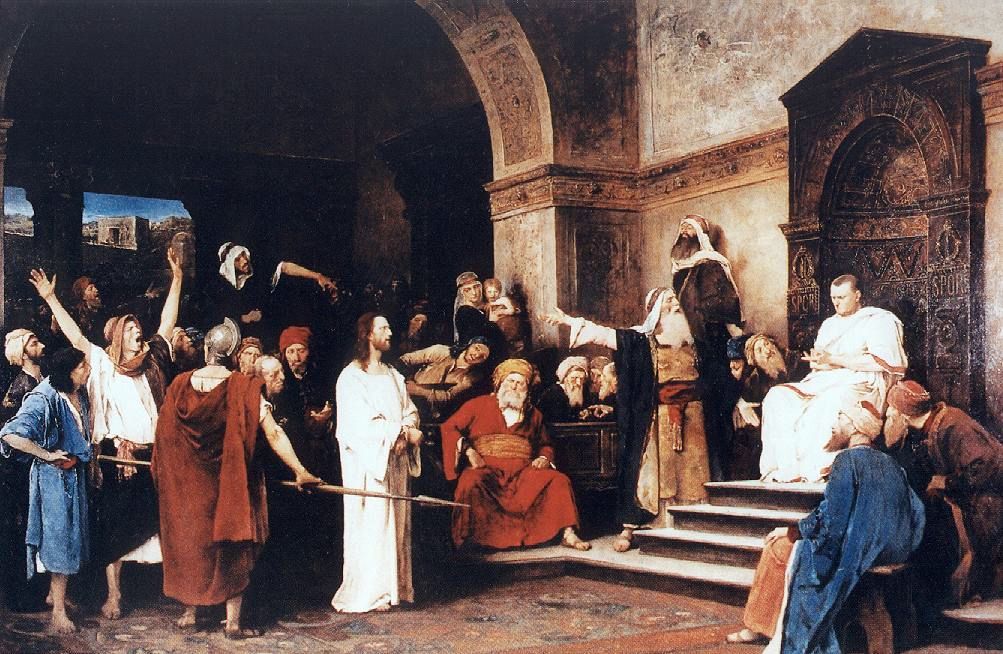
Christ in Front of Pilate, by Mihály Munkácsy (1881)

Many hymns have been written over the centuries extolling God's great love in sending his Son to suffer and die in our place so that we might live with Him forever.  But none bring home this awesome truth in a more concrete and personal way than My Song is Love Unknown. The text was written by Samuel Crossman (1623 -- 1683), an English clergyman (of whom no image is known to exist), and was first published in 1664 as a poem in his short book The Young Man’s Meditation, or Some Few Sacred Poems upon Select Subjects and Scriptures. Crossman was born in Suffolk, England, in 1623.  After earning a bachelor of divinity degree at Pembroke College, Cambridge, he ministered at first to both an Anglican and a separate Puritan congregation.Although he had strong Puritan sympathies, he was a non-separatist who tried to reconcile differences with the Anglican establishment. After the Church of England expelled Crossman and about 2,000 other ministers with similar sympathies in 1662, he renounced Puritanism, rejoined the Church, and became a royal chaplain in 1665. He moved to a post at Bristol Cathedral in 1667 and became its Dean in 1683, shortly before his death. He now lies buried beneath the south aisle of the cathedral.

Here is the exquisite text of Crossman's poem, which--reflecting on all the salient events of Holy Week and our Lord's Passion--poignantly expresses sorrow for sin and fervent love for the One who gave up His glory and His life that it might be forgiven:
My song is love unknown,
My Saviour’s love to me;
Love to the loveless shown,
That they might lovely be.
O who am I, that for my sake
My Lord should take frail flesh and die?

He came from His blest throne
Salvation to bestow;
But men made strange, and none
The longed-for Christ would know:
But O! my Friend, my Friend indeed,
Who at my need His life did spend.

Sometimes they strew His way,
And His sweet praises sing;
Resounding all the day
Hosannas to their King:
Then “Crucify!” is all their breath,
And for His death they thirst and cry.

Why, what hath my Lord done?
What makes this rage and spite?
He made the lame to run,
He gave the blind their sight,
Sweet injuries! Yet they at these
Themselves displease, and ’gainst Him rise.

They rise and needs will have
My dear Lord made away;
A murderer they save,
The Prince of life they slay,
Yet cheerful He to suffering goes,
That He His foes from thence might free.

In life, no house, no home
My Lord on earth might have;
In death no friendly tomb
But what a stranger gave.
What may I say? Heav’n was His home;
But mine the tomb wherein He lay.

Here might I stay and sing,
No story so divine;
Never was love, dear King!
Never was grief like Thine.
This is my Friend, in Whose sweet praise
I all my days could gladly spend.
It isn't altogether clear what Crossman meant by "love unknown"--love beyond comprehension, perhaps? Or love unknown and unappreciated by those to whom it's extended?  The first stanza itself may hold the answer: "Love to the loveless shown/That they might lovely be."  We are surely the "loveless," not returning love to Him who freely gave it, that we who were yet sinners might be spotless as He is. (Romans 5:8)

The Crucifixion of Jesus Christ
Note also the personal intimacy reflected throughout the hymn: "who am I, that for MY sake/MY Lord should take frail flesh and die?"  And in the second stanza: "O! MY Friend, MY Friend indeed,/Who at MY need His life did spend."  This theme of "friendship" with Jesus--a very personal relation indeed--is sounded throughout the hymn. (John 15:12-14)  So too is the believer's anguish at the way his "Friend" was first hailed and then betrayed, scorned, murdered, and abandoned by the very people He had come to heal and save--including the believer, who acknowledges that Christ's tomb was where he himself should have lain in death, but for his Savior's love. The hymn is closed by two of the simplest, sweetest lines ever penned: "This is my Friend, in Whose sweet praise/I all my days could gladly spend."

John Ireland
Crossman's poem has been set to a number of different tunes, but the one best-known and most often sung today was written by English composer John Ireland (1879 – 1962). Ireland is said to have composed the melody over lunch one day, within fifteen minutes on a scrap of paper, at the suggestion of organist and fellow-composer Geoffrey Shaw.  The tune, called Love Unknown (appropriately enough), was first published in 1919 in The Public School Hymn Book, of which Shaw was an editor.

[NOTE: Although the work is in the public domain in the USA, I have not been able to locate and reproduce here a copy of the sheet music to Ireland's tune.]


* * * * *
Here are three very different, but all very beautiful, renditions of this precious hymn. The first is a traditional arrangement sung by the Wells Cathedral Choir:


The next is a solo rendition by British singer and vocal coach Sylvia Burnside. This may be even a better way to sing this hymn, as a solo presentation accentuates its intensely personal, emotional nature, and the words are more easily understood.


The third rendition is another solo, by contemporary Christian singer/composer/arranger Fernando Ortega. This version apparently follows the tune Rhosymedre, by Welsh Anglican hymnist John David Edwards (1805 – 1885). It's almost as appealing as John Ireland's tune Love Unknown, but the latter seems--to my ear at least--to better fit the spirit of the text.


* * * * *
Never doubt God's love for YOU. You're as precious to Him as any and every other one of His children. Remember that Christ came to earth to save YOU, to pay for YOUR sins, no matter what they might be--and would have done so if even you were the only sinner who had ever lived. He loved YOU so much, that He went through all that He did just so He could have YOUR company in Heaven forever. There's never been a greater miracle. It truly is the Greatest Love Story Ever Told!

The Resurrection of Christ, by Jacopo Tintoretto

For I am persuaded, that neither death, nor life, nor angels, nor principalities, nor powers, nor things present, nor things to come, Nor height, nor depth, nor any other creature, shall be able to separate us from the love of God, which is in Christ Jesus our Lord . . .
      ~ Romans 8:38-39

Wednesday, March 21, 2012

What Wondrous Love Is This?


In this was manifested the love of God toward us, because that God sent his only begotten Son into the world, that we might
live through him.
Herein is love, not that we loved God, but that he loved us,
and sent his Son
to be the propitiation for our sins.

~ 1 John 4:9-10

Among the miracles of sacred music is that one doesn't have to have an extensive education in writing to compose inspiring text, nor in composition or arrangement to marry the text with a beautiful, moving tune. Nor is great skill or experience in musical performance needed to sing most of the exquisitely moving hymns that have come down to us over the centuries. Many of the most famous and moving hymns familiar to us today, sung in churches and in gatherings of Christian believers throughout the world, sprang from the spiritual experiences and sentiments of unknown humble people living otherwise ordinary lives, in remote times and places. These treasures have become enshrined in our culture through oral tradition, often aided by the work of more educated men and women who sojourned among the common people and preserved their best native music in compilations from which organized churches later drew much of the material for their hymnals and songbooks, thus bringing them out of obscurity and into the spiritual experience of believers everywhere.
Link
A leading example of these "folk hymns" is the hauntingly beautiful What Wondrous Love is This?, often titled simply Wondrous Love. Its discovery and preservation are most widely attributed to William Walker (1809-1875), an American Baptist song leader, shape note "singing master," and compiler of folk music. A brief biography notes that while yet a teenager the musically gifted Walker led congregational singing at the First Baptist Church in his home town of Spartanburg, South Carolina; later he collected and arranged folk tunes, and participated in singing schools and compiled melodies from southern Appalachia and camp meetings. After moving to Hartford, Connecticut, Walker published The Southern Harmony and Musical Companion in 1835, using the shaped note music notation system that was for generations the foundation of musical teaching in rural America, and on which the "Sacred Harp" singing tradition is based. Wondrous Love was included in this compilation, and from it this hymn gained its first widespread exposure (although it may have first appeared in print in earlier, lesser-known compilations).


William Walker and his Southern Harmony and Musical Companion, 1835

True to its folk origins, the melody of Wondrous Love appears to be a variant of a once-familiar dance tune that was set to the text of a song called "Captain Kid." The tune is in a form of minor called Dorian mode, which gives the hymn its "haunting" or "plaintive" character. This mode also leaves an impression that the melody should end one step lower than it does, producing a sense of incompletion--when it is over, one feels as if there is still more to sing. This is serves as an invitation to repetition, which is central to the hymn's appeal.

This becomes clear from the text of Wondrous Love, which recounts and celebrates the central truth, and most precious miracle, of being: that Justice and Mercy are One, that God is love (1 John 4:8), and that to save every person from his own sins, the innocent Lord of All left His glorious throne in Eternity and, while we were yet sinners, gave His life for us (Romans 5:8).
What wondrous love is this, O my soul, O my soul!
What wondrous love is this, O my soul!
What wondrous love is this that caused the Lord of bliss
To bear the dreadful curse for my soul, for my soul,
To bear the dreadful curse for my soul.


When I was sinking down, sinking down, sinking down,
When I was sinking down, sinking down,
When I was sinking down beneath God’s righteous frown,
Christ laid aside His crown for my soul, for my soul,
Christ laid aside His crown for my soul.


To God and to the Lamb, I will sing, I will sing;
To God and to the Lamb, I will sing.
To God and to the Lamb who is the great "I Am";
While millions join the theme, I will sing, I will sing;
While millions join the theme, I will sing.


And when from death I’m free, I’ll sing on, I’ll sing on;
And when from death I’m free, I’ll sing on.
And when from death I’m free, I’ll sing and joyful be;
And through eternity, I’ll sing on, I’ll sing on;
And through eternity, I’ll sing on.

Despite the tune's minor key, which is often associated with sadness, Wondrous Love bursts with the redeemed sinner's joyful exultation, thankfulness, and praise for his Savior. This glorious theme is strengthened by the repetition in each stanza, which not only made the hymn easy to learn and remember for the 19th century Appalachian pioneers who first sang it, but also (as one observer notes), functions like a rhythmic incantation or mantra, building and reinforcing the power of the message as the hymn progresses. Beginning with a sense of wonder and awe, the hymn becomes a triumphant anthem that literally echoes "through eternity."

As this is a folk-based song published a number of times in various compilations and hymnals since the early 19th century, there are many additional or alternative verses, and there have been a number of arrangements.

Several excellent video performances of Wondrous Love are available; my only difficulty was choosing which to feature here. The rendition below is a capella by the fine bluegrass group Mountain Blue--and the video presents a host of inspiring images of our Savior:


The next rendition is by American folksinger and songwriter Connie Dover in a vaguely Celtic style, accompanied by uilleann pipes and synthesized background music. The verses here are more numerous and depart somewhat from the traditional text--focusing less on Christ's bearing of our guilt than on the joy of knowing His love--but are still historically grounded, and beautiful.The video features stunning images of Michelangelo's Pieta and other great works of Christian art:


Christian artist Fernando Ortega presents a unique and beautiful arrangement for solo piano and cello, accompanying his achingly expressive voice:


And now for something completely different--yet, perhaps, truest to its origins: Wondrous Love sung in the "Sacred Harp" style! This was recorded at the Southwest Theological Seminary, Fort Worth Texas, in January 2012:


As we remember the Passion of our Lord during this Lenten season, and approach the precious time of Easter, let us all "sing and joyful be," and keep always in our hearts and minds the Wondrous Love that makes possible life with Him "through all eternity"!


But we see Jesus,
who was made a little lower than the angels
for the suffering of death,
crowned with glory and honour;
that He by the grace of God
should taste death for every man.

~ Hebrews 2:9