Showing posts with label Military. Show all posts

Saturday, November 10, 2012

Eternal Father, Strong to Save (Navy Hymn)


And, behold, there arose a great tempest in the sea, insomuch that the ship was covered with the waves: but he was asleep. And his disciples came to him, and awoke him, saying, Lord, save us: we perish. And he saith unto them, Why are ye fearful, O ye of little faith? Then he arose, and rebuked the winds and the sea; and there was a great calm. But the men marvelled, saying, What manner of man is this, that even the winds and the sea obey him! ~ Matt. 8:24-27

Sunday, November 11, is Veterans Day in the United States and Remembrance Day in Great Britain and the Commonwealth (click here for my 2011 post on observance of this day). Established in the 1920s to commemorate the signing of the Armistice on November 11, 1918 that ended World War I, Veterans Day has since been re-christened in the United States as an occasion to remember and honor all men and women who have served in the Armed Forces of the United States, from Revolutionary times to the present. Given how many of them made the ultimate sacrifice to preserve freedom for us all, and how close so many service members live to the edge of mortality, day in and out, the singing of hymns in their remembrance is most fitting.
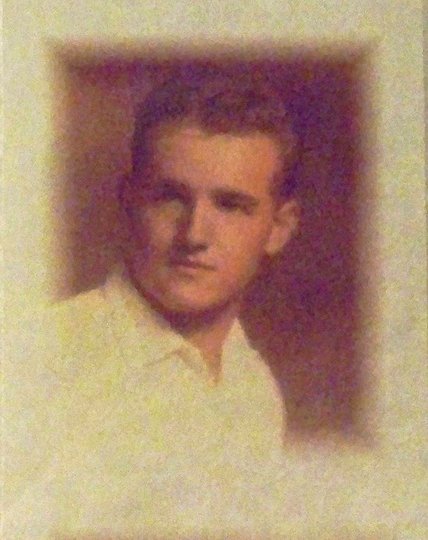
John W. Fleming
Veterans Day is special to me, in large part, because my father (at left, as a young man) is a veteran of the United States Navy (and, while he served as a Hospital Corpsman with occupation forces in 1950s Japan, of the United States Marine Corps).  He is very proud of his service, and so is everyone in our family! In his honor, I'd like to feature the hymn most closely associated with the Navy and sailors in general, Eternal Father, Strong to Save.

According to the Naval History and Heritage Command, the work known to United States Navy men and women as the "Navy Hymn" is a musical benediction long having a special appeal to seafarers, particularly in the American Navy and the Royal Navies of the British Commonwealth. The original text was written as a poem by a schoolmaster and clergyman of the Church of England, the Rev. William Whiting (1825-1878). He resided on the English coast near the sea and at the age of 35 survived a furious storm while on a voyage in the Mediterranean. Later, a student came to Whiting and confided to him an overwhelming fear of the ocean, which he had to cross in order to travel to America. Whiting told him of his experiences on the ocean, and assured him: "Before you depart, I will give you something to anchor your faith."

William Whiting
The compilers of Hymns Ancient and Modern revised the text when they included it in their first edition in 1861 to the form in which it is now known. Whiting himself rewrote the entire hymn in 1869, and it is this version which is found in most hymnals. Also in 1861, the text was adapted to music by another English clergyman, the Rev. John Bacchus Dykes (1823-1876), who originally wrote the music as "Melita," an ancient name for the Mediterranean island of Malta, where the Apostle Paul was supposedly shipwrecked. Rev. Dykes composed the music to many other well-known hymns, including Lead, Kindly Light; Holy, Holy, Holy; Jesus, Lover of My Soul; and Nearer, My God to Thee.
John B. Dykes

Whiting's text presents us with an eloquent expression of man's frailty before God and the power of His Creation, and with a moving prayer for His continued mercy and loving protection. Dykes' music is like the sea itself, rising and falling; brooding, ascending, and finally coming to rest. No wonder it has been the sailor's favorite for more than 150 years!
Eternal Father, strong to save,
Whose arm hath bound the restless wave,
Who bidd'st the mighty ocean deep
Its own appointed limits keep;
Oh, hear us when we cry to Thee,
For those in peril on the sea!

O Christ! Whose voice the waters heard
And hushed their raging at Thy word,
Who walkedst on the foaming deep,
And calm amidst its rage didst sleep;
Oh, hear us when we cry to Thee,
For those in peril on the sea!   

Most Holy Spirit! Who didst brood
Upon the chaos dark and rude,
And bid its angry tumult cease,
And give, for wild confusion, peace;
Oh, hear us when we cry to Thee,
For those in peril on the sea!

O Trinity of love and power!
Our brethren shield in danger's hour;
From rock and tempest, fire and foe,
Protect them wheresoe'er they go;
Thus evermore shall rise to Thee
Glad hymns of praise from land and sea.

Eternal Father, Strong to Save has had an interesting history since its first publication. In 1879 Lt. Comdr. Charles Jackson Train, an 1865 graduate of the United States Naval Academy who went on to become a Rear Admiral, was stationed at the Academy in charge of the Midshipman Choir. In that year Train inaugurated the tradition, still observed, of concluding each Sunday's Divine Services at the Academy with the singing of the first verse of this hymn.

Winston Churchill requested the singing of Eternal Father, Strong to Save at a church service aboard the Royal Navy battleship HMS Prince of Wales during his 1941 conference with President Franklin D. Roosevelt for creation of the Atlantic Charter. Ironically, this was also the last hymn sung during the Sunday, April 14, 1912 church service aboard the RMS Titanic just hours before it sank. It was sung at the funeral of President Roosevelt (who had previously served as Secretary of the Navy); played by the Navy Band at the funeral of President John F. Kennedy, a World War II PT-boat commander; sung at the funeral of former President Richard Nixon; and played by the Navy and Coast Guard Bands during the funeral of the late President Ronald Reagan. The hymn was performed by the U.S. Navy Sea Chanters   at the funeral of President Gerald R. Ford, who had served in the Navy during World War II in the Pacific Theater. This was also the final hymn sung at the 2011 funeral in Australia of Claude Choules, the last living seaman and combat veteran of World War I.

Eternal Father, Strong to Save, and variants of it for every branch of service from submariners, Marines, Seabees, and airmen to Coast Guardsmen, nurses, astronauts, and even Arctic explorers, has been performed in such popular films as Crimson Tide, The Right Stuff, The Perfect Storm, and Titanic.

*****
The video below features a congregation singing Eternal Father, Strong to Save with moving scenes of seamen, ships, crashing waves, and cathedral windows memorializing the sea service:


This presentation is by the Naval Academy Men's Glee Club in a 2008 visit to San Antonio, Texas:


There are many times in life when we feel utterly helpless and in peril of our lives, at the mercy of dark, raging forces we cannot stem. We call upon God to save us, as He is the only One with power and love enough to move all Creation to protect us from destruction. Give joyful thanks and praise always that we can trust always in the arms of such a faithful Lord!


They that go down to the sea in ships, that do business in great waters; these see the works of the Lord, and his wonders in the deep. For he commandeth, and raiseth the stormy wind, which lifteth up the waves thereof. They mount up to the heaven, they go down again to the depths: their soul is melted because of trouble. They reel to and fro, and stagger like a drunken man, and are at their wit's end. Then they cry unto the Lord in their trouble, and he bringeth them out of their distresses. He maketh the storm a calm, so that the waves thereof are still. Then are they glad because they be quiet; so he bringeth them unto their desired haven. ~ Psalm 107:23-30

Sunday, May 27, 2012

Mansions of the Lord


He maketh wars to cease unto the end of the earth;
he breaketh the bow, and cutteth the spear in sunder;
he burneth the chariot in the fire. ~ Psalms 46:9

Tomorrow, May 28, is Memorial Day in the United States. On this day we remember and honor those men and women in the Armed Forces who gave their lives in service to our country. Today, for those who have never lost a close relative or friend serving in the military, Memorial Day seems to mean little more than an extra day off from work and an occasion for picnics and used car sales. But for those who have borne such a loss, or who have simply made it their business to honor our fallen heroes and support their families, Memorial Day is a profoundly moving time.

But not always a somber, wretched time. Perhaps because Memorial Day falls in the fullest flower of spring, it has always cast for me a ray of light and hope, just behind the dark wall of painful remembrance. As a child I would go with my grandmother every "Decoration Day"--as it was then called--to the cemetery behind our family's church, where we laid a pot of flowers at my long-departed grandfather's grave and with Grandma would say a brief, silent prayer. I recall it as always being sunny and warm. All the veterans' graves were adorned with colorful flags. Yes, we often had a family picnic too, but it was always preceded by that quiet remembrance.

This bonding of grief and hope, sadness and peace is reflected in a moving contemporary hymn to fallen servicemen called Mansions of the Lord. The text was composed by Christian songwriter, screenwriter, and director Randall Wallace, and the music by English film score composer Nick Glennie-Smith.It was sung by the U.S. Military Academy Glee Club during the closing credits of the 2002 film We Were Soldiers, which chronicled the November 1965 Battle of Ia Drang in Viet Nam. The hymn also served as the recessional in the 2004 funeral of President Ronald Reagan.

 Randall Wallace and Nick Glennie-Smith

The text consists of three short stanzas that dwell not on war and death, but on the eternal peace of Heaven--the "Mansions of the Lord"--to which a fallen soldier (or sailor or airman) is commended by his comrades, who promise to stand guard and remember him always. The hymn reminds us that in that blessed place there is no more war, no fear or pain, no anguish or loss--just "divine embrace, eternal light." The music is likewise simple, dignified, and uplifting, and reinforces the text's message of hope (as the hymn is not in the public domain the sheet music can't be reproduced here, but if you'd like to view and download it for a fee, click here).
To fallen soldiers let us sing,
Where no rockets fly nor bullets wing,
Our broken brothers let us bring
To the Mansions of the Lord.

No more bleeding, no more fight,
No prayers pleading through the night,
Just divine embrace, eternal light
In the Mansions of the Lord.

Where no mothers cry and no children weep,
We will stand and guard though the angels sleep,
All through the ages safely keep
The Mansions of the Lord.
  Tomb of the Unknown Soldier, Washington, DC, USA

The presentation below is the original version of the hymn sung in We Were Soldiers by the Cadet Glee Club of West Point, along with a stirring orchestration and a moving video tribute to fallen warriors and their families:


You'll notice that this presentation includes a solo voice portion not part of the hymn itself, excerpted from the lament "Sgt. MacKenzie" by Joseph Kilna MacKenzie, as sung in a Scottish dialect and with a "translation" to standard English:
Lay me doon in the caul caul groon
Whaur afore monie mair huv gaun
Lay me doon in the caul caul groon
Whaur afore monie mair huv gaun

Ains a year say a prayer faur me
Close yir een an remember me
    *****
Lay me down in the cold cold ground
Where before many more have gone
Lay me down in the cold cold ground
Where before many more have gone

Once a year say a prayer for me
Close your eyes and remember me
 Below is another presentation, also sung (I believe) by the Cadet Glee Club but without orchestration--except for a very poignant bugle introduction--and is accompanied by another very moving video.


The video below presents the Cadet Glee Club itself performing Mansions of the Lord, with an introduction that provides some very thought-provoking information on just how many men and women have given their lives in America's service in the last hundred years:


War, though sometimes necessary in the defense of truth, justice, and national survival, is perhaps the greatest scourge in human experience. The believer--especially the believing soldier and his or her family--longs and prays for the day when war and conflict are no more, and we rejoice eternally, together, in the presence of our Savior and Heavenly Father.  It is this hope that we share with departed loved ones, and which, perhaps, inspired these beautiful passages from Scripture:

[T]hey shall beat their swords into plowshares,
and their spears into pruning hooks;
nation shall not lift up sword against nation,
neither shall they learn war anymore. ~ Isaiah 2:4

And God shall wipe away all tears from their eyes;
and there shall be no more death,
neither sorrow, nor crying, neither shall there be any more pain:
for the former things are passed away. ~ Revelation 21:4


May the soldiers, sailors, and airmen of today live to see it,
and lock arms with their departed comrades once more.

Friday, November 11, 2011

O Valiant Hearts


Of all the themes addressed in the catalog of sacred music, few weigh more heavily on the soul than the the loss of those who have given their lives in military service. Whether it is heard or sung by a mourning friend or a family member, or merely by a grateful fellow citizen, a hymn of remembrance for the fallen can provide sorely needed comfort and assurance to the spirit that the departed soldier, sailor, or airman did not die in vain, but "gave the last full measure of devotion" (Abraham Lincoln, Gettysburg Address) to his or her country and everything that that it, and we, hold precious.

Military hymns are widely heard on November 11, which is observed as Veterans Day in the United States and as Remembrance Day in Great Britain and Commonwealth countries such as Canada, Australia, and New Zealand. These observances were established in the 1920s to commemorate the signing of the Armistice on November 11, 1918 that ended World War I--the so-called "War to End All Wars." If only it had been! The Great War, as it was called then, cost more than 117,00 American lives, but more than 10 million lives in Europe, in four short years. The fighting devastated large swaths of Europe, and with its mud-and-disease-ridden trench warfare, machine gunning, huge artillery barrages, and poison gas, involved combatants and civilians alike in a seemingly interminable orgy of suffering and death.

British wounded at Bernafay Wood, France, 19 July 1916

It's no wonder, then, that those who survived the Great War struggled to find some meaning in the tragic sacrifice of so many promising lives--young men they had known, loved, and cheered as they marched away into the most awful killing fields man has ever seen. For some, faith in God was shattered, but others turned to Him for comfort and hope with an even greater devotion. From that spirit was born the heart-rending, yet stirring hymn O Valiant Hearts. The text was taken from a poem by Sir John Stanhope Arkwright (1872–1954), a member of Parliament from Herefordshire, England, and published in "The Supreme Sacrifice, and other Poems in Time of War"(1919). It was set to music by Dr. Charles Harris, who was the vicar of Colwall in the same county. The combination of Harris' tune and Arkwright's words was an immediate success; the hymn was sung at the dedication of the Tomb of the Unknown Warrior in Westminster Abbey, London, on November 11 1920. Interestingly, according to a BBC feature on the hymn, "both men knew the pain of losing a loved one first hand - Dr. Harris lost a son in the First World War, and one of Sir John's two sons was killed in a submarine accident in World War II."

Sir John Stanhope Arkwright

The text and music of O Valiant Hearts are below:
O Valiant Hearts, who to your glory came
Through dust of conflict and through battle-flame,
Tranquil you lie, your knightly virtue proved,
Your memory hallowed in the Land you loved.

Proudly you gathered, rank on rank to war,
As who had heard God's message from afar;
All you had hoped for, all you had, you gave
To save Mankind - yourselves you scorned to save.

Splendid you passed, the great surrender made,
Into the light that nevermore shall fade;
Deep your contentment in that blest abode,
Who wait the last clear trumpet-call of God.

Long years ago, as earth lay dark and still
Rose a loud cry upon a lonely hill,
While in the frailty of our human clay
Christ, our Redeemer, passed the self-same way.

Still stands his cross from that dread hour to this

Like some bright star above the dark abyss;
Still through the veil the victor's pitying eyes
Look down to bless our lesser Calvaries.

These were his servants, in his steps they trod,
Following through death the martyr'd Son of God:
Victor he rose; victorious too shall rise
They who have drunk his cup of sacrifice.

O risen Lord, O shepherd of our dead,

Whose cross has bought them and whose staff has led-
In glorious hope their proud and sorrowing land
Commits her children to thy gracious hand.

What most impresses me about O Valiant Hearts is the compelling way in which it compares the brave sacrifice of the men who fought for their country and people with the selfless sacrifice of Christ ("[t]o save Mankind - yourselves you scorned to save.") Our Lord is presented as the One who showed the way through awful trial to eternal victory, and in whose footsteps the valiant marched: "These were his servants, in his steps they trod/Following through death the martyr'd Son of God:/Victor he rose; victorious too shall rise/They who have drunk his cup of sacrifice." No greater tribute could be paid to fighting men than this.

This moving video presentation of O Valiant Hearts features the singing of the Chapel Choir of the Royal Hospital, Chelsea, and was created as a tribute to the author's grandfather and father, who fought in World Wars I and II, respectively.


Greater love hath no man than this,
that a man lay down his life for his friends.

~ John 15:13