Showing posts with label Patriotic. Show all posts

Tuesday, June 11, 2013

Battle Hymn of the Republic


Irish Brigade Monument, Antietam National Battlefield

A couple of weeks ago (May 27) people in the United States observed Memorial Day, on which we  remember and honor those who gave their lives while serving our country in the armed forces.  In less than a month (July 1-3), we will mark the 150th anniversary of the Battle of Gettysburg, the costliest and, perhaps, most decisive engagement in the American Civil War.  Dark clouds of wars past, as well as the "wars and rumors of wars" today, are on our minds.  For centuries, people have resorted to sacred music as a way to find meaning, comfort, and inspiration amidst the terrible trials that wars produce. Sometimes a hymn will reflect on what has been lost in past conflicts, especially fallen warriors, and at other times (and often in the same hymn) on the causes for which the war was fought.

War, for a Christian, is among the most troubling features of life in this world. We believe that our God is loving and merciful, yet untold millions of innocent  human beings have been killed, maimed, starved, enslaved, and otherwise suffered in countless wars down through history, a scourge which seems to have no end. God commands us not to kill (Exodus 20:13), but legions of professing Christians have taken up arms, and still do, to defend their homelands or way of life--and too often in the past, most regrettably, to engage in conquest and even to war against each other.  We pray fervently for peace and look forward to the blessed day when "they shall beat their swords into plowshares, and their spears into pruning hooks: nation shall not lift up sword against nation, neither shall they learn war any more." (Isaiah 2:3-4)  And yet, we "put on the whole armour of God" (Ephesians 6:11) and sing rousing hymns that are full of military imagery, such as Onward Christian Soldiers, Who Is on the Lord’s Side?, and Stand Up, Stand Up for Jesus, Ye Soldiers of the Cross. Ultimately, perhaps, war is but one facet of the opposition and conflict that came into the world with sin, and will be our lot until Christ returns and banishes Satan forever.

This view suffuses one of Christendom's (and the world's) most famous hymns, The Battle Hymn of the Republic.  This remarkable work may be less of a "hymn" as commonly understood, than an anthem, for it became the inspirational "theme" music for the Union (or perhaps more precisely, the abolitionist) cause in the American Civil War. While it reflects on the issues that gave rise to that war and invokes images common to the 19th century soldier's experience, the Battle Hymn elevates the conflict to a higher, sacred plane and speaks to what many Christians believe about evil, the destiny of the world, and our role in fulfilling that destiny.

THE HISTORY BEHIND THE HYMN

The text of the Battle Hymn was written in 1861 by Julia Ward Howe (1819–1910), a prominent American social activist and wife of Samuel Gridley Howe (1801–1876), a famed scholar in education of the blind. Samuel and Julia were both deeply involved in the anti-slavery or "abolitionist" movement, in which thousands of Americans had, for more than thirty years, worked tirelessly to end the practice of slavery in the United States through religious and moral persuasion, political agitation, and even spiriting slaves away to the Northern states and Canada from their places of bondage in the South. Many abolitionists had exhausted their fortunes and risked (and some suffered)  prison or death in the cause. The movement grew out of the American religious revival known as the the Second Great Awakening in the 1820s and 1830s, and its most passionate and committed members were motivated by the conviction that "all people were equal in God's sight; the souls of black folks were as valuable as those of whites; [and] for one of God's children to enslave another was a violation of the Higher Law, even if it was sanctioned by the Constitution." (James Brewer Stewart, Holy Warriors: The Abolitionists and American Slavery (1976)). They were also convinced, as were most zealous believers since the Second Great Awakening, that the Millennium was near and that Jesus Christ would return to the earth soon to usher it in. That society could and should be transformed for the better in furtherance of God's purpose, and that it was the Christian's duty to help bring about that transformation, was an article of faith among religious abolitionists and social reformers of that day.

John Brown
By the 1860s the abolition movement seemed--but for the liberation of some thousands of slaves through the "underground railroad"--to have borne little fruit but to set the Northern and Southern sections of the United States implacably against each other. The 1859 assault on the federal arsenal at Harpers Ferry, Virginia led by John Brown, a deeply religious abolition zealot who sought to spark a slave uprising--and which was funded in part by Samuel Gridley Howe--only hastened the rupture. Finally, five months after anti-slavery Republican Abraham Lincoln was elected President of the United States in November 1860, and several Southern states seceded from the Union, the conflict became an open and deadly Civil War.

According to various accounts, the Battle Hymn was born in the wake of a public review of federal troops outside Washington, D.C. in November 1861, which Julia Ward Howe attended along with her husband Samuel--now a member of President Lincoln's military Sanitary Commission--and the Rev. James Freeman Clarke. At some point the passing soldiers began singing John Brown's Body, a popular Union marching song that referred both to the famous antislavery martyr John Brown and to a certain irrepressible Union soldier of that name from Massachusetts. John Brown's Body itself originated from a popular religious camp-meeting song known as Canaan's Happy Shore or Brothers, Will You Meet Us?, which carried an old folk tune transcribed (and often attributed to) William Steffe (1830–1890), (of whom no known image exists) and published in about 1856. Although the words to John Brown's Body were thought by the more genteel people of the time as rather coarse and irreverent, Mrs. Howe and her party joined in the singing as the soldiers marched by. Reverend Clarke suggested to Mrs. Howe that she write some new lyrics to the familiar tune, and she resolved to do so. As she later recalled:
I went to bed that night as usual, and slept, according to my wont, quite soundly. I awoke in the gray of the morning twilight; and as I lay waiting for the dawn, the long lines of the desired poem began to twine themselves in my mind. Having thought out all the stanzas, I said to myself, 'I must get up and write these verses down, lest I fall asleep again and forget them.' So, with a sudden effort, I sprang out of bed, and found in the dimness an old stump of a pen which I remembered to have used the day before. I scrawled the verses almost without looking at the paper. [Howe, Julia Ward. Reminiscences: 1819-1899. Houghton, Mifflin: New York, 1899. p. 275]
Howe's Battle Hymn of the Republic was first published on the front page of the February 1862 issue of the Atlantic Monthly (editor James T. Fields (1817-1881), who paid Mrs. Howe $5 for the piece, is credited with having given the song the name by which it is known today). By the time federal forces  took the field for their spring campaigns, soldiers were already singing and marching to the song.

Since the Civil War, the Battle Hymn has become one of the USA's most beloved patriotic songs. It also appears in many hymnals, and is widely sung at church services on such national holidays as Memorial Day and Independence Day. It is probably second in eminence only to The Star Spangled Banner as an American patriotic anthem.

THE MEANING AND IMPORTANCE OF THE HYMN

One cannot fully appreciate the meaning and significance of the Battle Hymn without reading and pondering its text in detail:

    Mine eyes have seen the glory of the coming of the Lord:
    He is trampling out the vintage where the grapes of wrath are stored;
    He hath loosed the fateful lightning of His terrible swift sword:
    His truth is marching on.

       
(Chorus)
        Glory, glory, hallelujah!
        Glory, glory, hallelujah!
        Glory, glory, hallelujah!
        His truth is marching on.

    I have seen Him in the watch-fires of a hundred circling camps,
    They have builded Him an altar in the evening dews and damps;
    I can read His righteous sentence by the dim and flaring lamps:
    His day is marching on.

       
(Chorus)
        Glory, glory, hallelujah!
        Glory, glory, hallelujah!
        Glory, glory, hallelujah!
        His day is marching on.

    I have read a fiery gospel writ in burnished rows of steel:
    "As ye deal with my contemners, so with you my grace shall deal;
    Let the Hero, born of woman, crush the serpent with his heel,
    His truth is marching on."

       
(Chorus)
        Glory, glory, hallelujah!
        Glory, glory, hallelujah!
        Glory, glory, hallelujah!
        His truth is marching on.

    He has sounded forth the trumpet that shall never call retreat;
    He is sifting out the hearts of men before His judgment-seat:
    Oh, be swift, my soul, to answer Him! be jubilant, my feet!
    Our God is marching on.

       
(Chorus)
        Glory, glory, hallelujah!
        Glory, glory, hallelujah!
        Glory, glory, hallelujah!
        Our God is marching on.

    In the beauty of the lilies Christ was born across the sea,
    With a glory in His bosom that transfigures you and me:
    As He died to make men holy, let us die to make men free,
    While God is marching on.

       
(Chorus)
        Glory, glory, hallelujah!
        Glory, glory, hallelujah!
        Glory, glory, hallelujah!
        Our God is marching on.

    He is coming like the glory of the morning on the wave,
    He is Wisdom to the mighty, He is Succour to the brave,
    So the world shall be His footstool, and the soul of Time His slave,
    Our God is marching on.

       
(Chorus)
        Glory, glory, hallelujah!
        Glory, glory, hallelujah!
        Glory, glory, hallelujah!
        Our God is marching on.


The Battle Hymn of the Republic is certainly different from most of the works featured in this or like collections of hymns, which tend to focus on the individual and his or her personal transformation through God and Jesus Christ. The Battle Hymn, on the other hand, focuses on the world and the injustice and evil within it, and its impending transformation by Christ, heralded by and working through the armies of His faithful.

The first stanza presents a clear vision of the Lord's return and the fearful judgment coming in its wake:  "glory of the coming of the Lord" (". . . the Son of man coming in the clouds of heaven with power and great glory." Matthew 24:30); "grapes of wrath" ("And the angel thrust in his sickle into the earth, and gathered the vine of the earth, and cast it into the great winepress of the wrath of God."  Revelation 14:19); "terrible swift sword" (". . . out of his mouth went a sharp twoedged sword . . ."  Revelation 1:16).

As has been noted elsewhere, the main element of the chorus--"Glory! Glory! Hallelujah!"-- was probably also inspired by the book of Revelation: " . . . I heard a great voice of much people in heaven, saying, Alleluia; Salvation, and glory, and honour, and power, unto the Lord our God . . ."  (Revelation 19:1).

In the second and third stanzas, the Lord is seen in "the watchfires;" His righteous sentence and His fiery gospel are read in "the dim and burning lamps" and in "burnished rows of steel" (ranks of polished musket barrels). These are things characteristic of soldier life, so the hymn suggests that the army itself constitutes the Lord's "terrible swift sword" and, perhaps, the "Hero born of woman" which is to "crush the serpent" underfoot.

The fourth stanza's reference to the "trumpet that shall never call retreat" also invokes a familiar thing to soldiers of that day, the bugle, and suggests a stern call to duty and action, as well as to Judgment Day, "a day of the trumpet and alarm" (Zephaniah 1:14, 16). Tthat call is not one to be shirked or dreaded by a soldier in God's army, but embraced joyfully: "Oh, be swift, my soul, to answer Him! be jubilant, my feet!"

The fifth stanza is the true climax of the hymn, and reveals its core inspiration: Christ, the beauty and glory of his Person. As He died to free all people  from sin, so should we be ready to give our lives to bring freedom to others ("As He died to make men holy, let us die to make men free"). While the word "slavery" is never used in the Battle Hymn, its implication is unmistakable, given the times and the circumstances of the hymn's author and authorship.

In thus replacing the words to the earthy marching song John Brown's Body, Mrs. Howe clearly intended to give the soldiers' agonizing work a new and higher meaning: not just the conquest of a menacing adversary, not just restoration of the Union, but a deliverance of millions of helpless souls from the crushing evil of bondage, and redemption of the whole nation from guilt for that terrible sin. As another perceptive observer explains: "[Mrs. Howe's] hymn was an attempt to frame [the soldiers'] sacrifice, to place it within the context of a great and glorious cause. . . . the advance of God’s Kingdom on earth."

OUR CALL TO ACTION?

Perhaps it is well that the Battle Hymn omits specific reference to the racial slavery over which the Civil War was fought 150 years ago, for as it is written the hymn speaks eloquently to us today, and calls us to be defenders of the freedom God intended for all our brothers and sisters. No wonder that the Battle Hymn became an anthem of the 20th century's civil rights movement.  In his final sermon delivered in Memphis, Tennessee on the evening of April 3, 1968, the night before his assassination, Dr. Marin Luther King, Jr. closed with the first line of the Battle Hymn: "Mine eyes have seen the glory of the coming of the Lord!"  The Battle Hymn has also come to be associated with the American cause in confronting evil and oppression around the world. It was a favorite of British Prime Minister and World War II leader Winston Churchill, for example, and at his request was played at his funeral in 1965.

Some modern Christians are uncomfortable with the militancy of the Battle Hymn and its call to men and women for such deep and forceful involvement in worldly matters. In any such critique we need to be mindful of the social and religious currents, as well as of the desperate moral and political struggles, out of which it arose. Different conditions and attitudes prevail today, when the initiative for social reform has been largely assumed by, or ceded to, secular forces working through governments and their allied organizations. Moreover, and ominously, there is in our society a growing resistance to the involvement of religious elements in public life. Nevertheless, who but those inspired by the love and teachings of Christ are better suited to show the compassion and self-sacrifice today's world so desperately needs?  Do Christian believers simply stand aside and let the relentless tide of evil (violence, class/ethnic/sectarian enmity, abortion) wash over the world while we gaze upwards waiting for deliverance?  To put it in Civil War terms, should we yield the moral battlefield and ground arms until our General appears to do the fighting for us?  Or do we, in Christ's name and spirit, march forward now and do what we can, until He returns, to dispel Satan's lies and extend God's deliverance to all His beleaguered children?  Even if we do so with plowshares instead of swords, the Battle Hymn of the Republic would still be a perfect anthem for our efforts.

* * * * * * *
VIDEOS ABOUT THE HYMN

It's unusual to have multiple videos telling how a hymn came to be, and of its enduring significance--but the Battle Hymn is a very special piece. Here is the story of the hymn as told by the great actor and director Orson Welles:


Here is another fascinating video relating the story of the Battle Hymn by the great-great-great grandson of Julie Ward Howe:


* * * * * * *
PERFORMANCES OF THE HYMN

There are many excellent (and some not so satisfactory) video renditions of the Battle Hymn. Most present only the first, second, and fifth stanzas. I suppose they're the best-known and easiest to understand and relate to for modern listeners, although the fourth stanza is just as clear and inspiring as the others, in my humble opinion.

Most modern renditions also substitute "live" for the original "die" in the third line of the fifth stanza, making the line read: "As He died to make men holy, let us live to make men free."  It is unclear when and why this change became commonplace. Perhaps it was in reaction against what some find to be the hymn's unsettling militancy. Others believe that "live" is preferable because it embraces commitment and potential sacrifice of one's whole being, in life as well as in death. Out of faithfulness to the original work I generally prefer its wording, but philosophically I prefer "live" for the reason just given. I find either formulation most inspiring.

Here is the video I thought most impressive musically and visually, featuring full orchestration and a large (though, unfortunately, unidentified) choir:


Good solo performances on video are harder to come by. Here is a good one by Judy Collins, joined by a U.S. Army chorus and the Boys Choir of Harlem in a 1993 concert televised live from Washington, D.C.:


For those who prefer a more spiritual, less military presentation, here's one featuring singer Jim Nabors along with images of Christ and scenes from His life and mission on Earth (in contrast to most other renditions, this one features the first, fourth, and fifth stanzas of the hymn):


* * * * * * *

Triumph of Christ, by Gustave Dore (1868)
 . . . [T]hey shall see the Son of man coming in the clouds of heaven
with power and great glory.
And He shall send His angels with a great sound of a trumpet . . .

Matthew 24:30-31

Saturday, November 10, 2012

Eternal Father, Strong to Save (Navy Hymn)


And, behold, there arose a great tempest in the sea, insomuch that the ship was covered with the waves: but he was asleep. And his disciples came to him, and awoke him, saying, Lord, save us: we perish. And he saith unto them, Why are ye fearful, O ye of little faith? Then he arose, and rebuked the winds and the sea; and there was a great calm. But the men marvelled, saying, What manner of man is this, that even the winds and the sea obey him! ~ Matt. 8:24-27

Sunday, November 11, is Veterans Day in the United States and Remembrance Day in Great Britain and the Commonwealth (click here for my 2011 post on observance of this day). Established in the 1920s to commemorate the signing of the Armistice on November 11, 1918 that ended World War I, Veterans Day has since been re-christened in the United States as an occasion to remember and honor all men and women who have served in the Armed Forces of the United States, from Revolutionary times to the present. Given how many of them made the ultimate sacrifice to preserve freedom for us all, and how close so many service members live to the edge of mortality, day in and out, the singing of hymns in their remembrance is most fitting.

John W. Fleming
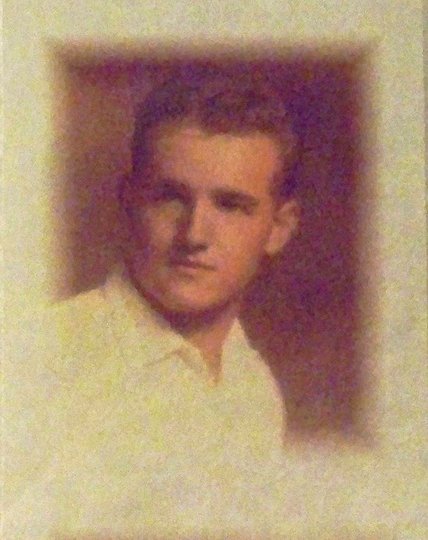
Veterans Day is special to me, in large part, because my father (at left, as a young man) is a veteran of the United States Navy (and, while he served as a Hospital Corpsman with occupation forces in 1950s Japan, of the United States Marine Corps).  He is very proud of his service, and so is everyone in our family! In his honor, I'd like to feature the hymn most closely associated with the Navy and sailors in general, Eternal Father, Strong to Save.

According to the Naval History and Heritage Command, the work known to United States Navy men and women as the "Navy Hymn" is a musical benediction long having a special appeal to seafarers, particularly in the American Navy and the Royal Navies of the British Commonwealth. The original text was written as a poem by a schoolmaster and clergyman of the Church of England, the Rev. William Whiting (1825-1878). He resided on the English coast near the sea and at the age of 35 survived a furious storm while on a voyage in the Mediterranean. Later, a student came to Whiting and confided to him an overwhelming fear of the ocean, which he had to cross in order to travel to America. Whiting told him of his experiences on the ocean, and assured him: "Before you depart, I will give you something to anchor your faith."

William Whiting
The compilers of Hymns Ancient and Modern revised the text when they included it in their first edition in 1861 to the form in which it is now known. Whiting himself rewrote the entire hymn in 1869, and it is this version which is found in most hymnals. Also in 1861, the text was adapted to music by another English clergyman, the Rev. John Bacchus Dykes (1823-1876), who originally wrote the music as "Melita," an ancient name for the Mediterranean island of Malta, where the Apostle Paul was supposedly shipwrecked. Rev. Dykes composed the music to many other well-known hymns, including Lead, Kindly Light; Holy, Holy, Holy; Jesus, Lover of My Soul; and Nearer, My God to Thee.
John B. Dykes

Whiting's text presents us with an eloquent expression of man's frailty before God and the power of His Creation, and with a moving prayer for His continued mercy and loving protection. Dykes' music is like the sea itself, rising and falling; brooding, ascending, and finally coming to rest. No wonder it has been the sailor's favorite for more than 150 years!
Eternal Father, strong to save,
Whose arm hath bound the restless wave,
Who bidd'st the mighty ocean deep
Its own appointed limits keep;
Oh, hear us when we cry to Thee,
For those in peril on the sea!

O Christ! Whose voice the waters heard
And hushed their raging at Thy word,
Who walkedst on the foaming deep,
And calm amidst its rage didst sleep;
Oh, hear us when we cry to Thee,
For those in peril on the sea!   

Most Holy Spirit! Who didst brood
Upon the chaos dark and rude,
And bid its angry tumult cease,
And give, for wild confusion, peace;
Oh, hear us when we cry to Thee,
For those in peril on the sea!

O Trinity of love and power!
Our brethren shield in danger's hour;
From rock and tempest, fire and foe,
Protect them wheresoe'er they go;
Thus evermore shall rise to Thee
Glad hymns of praise from land and sea.

Eternal Father, Strong to Save has had an interesting history since its first publication. In 1879 Lt. Comdr. Charles Jackson Train, an 1865 graduate of the United States Naval Academy who went on to become a Rear Admiral, was stationed at the Academy in charge of the Midshipman Choir. In that year Train inaugurated the tradition, still observed, of concluding each Sunday's Divine Services at the Academy with the singing of the first verse of this hymn.

Winston Churchill requested the singing of Eternal Father, Strong to Save at a church service aboard the Royal Navy battleship HMS Prince of Wales during his 1941 conference with President Franklin D. Roosevelt for creation of the Atlantic Charter. Ironically, this was also the last hymn sung during the Sunday, April 14, 1912 church service aboard the RMS Titanic just hours before it sank. It was sung at the funeral of President Roosevelt (who had previously served as Secretary of the Navy); played by the Navy Band at the funeral of President John F. Kennedy, a World War II PT-boat commander; sung at the funeral of former President Richard Nixon; and played by the Navy and Coast Guard Bands during the funeral of the late President Ronald Reagan. The hymn was performed by the U.S. Navy Sea Chanters   at the funeral of President Gerald R. Ford, who had served in the Navy during World War II in the Pacific Theater. This was also the final hymn sung at the 2011 funeral in Australia of Claude Choules, the last living seaman and combat veteran of World War I.

Eternal Father, Strong to Save, and variants of it for every branch of service from submariners, Marines, Seabees, and airmen to Coast Guardsmen, nurses, astronauts, and even Arctic explorers, has been performed in such popular films as Crimson Tide, The Right Stuff, The Perfect Storm, and Titanic.

*****
The video below features a congregation singing Eternal Father, Strong to Save with moving scenes of seamen, ships, crashing waves, and cathedral windows memorializing the sea service:


This presentation is by the Naval Academy Men's Glee Club in a 2008 visit to San Antonio, Texas:


There are many times in life when we feel utterly helpless and in peril of our lives, at the mercy of dark, raging forces we cannot stem. We call upon God to save us, as He is the only One with power and love enough to move all Creation to protect us from destruction. Give joyful thanks and praise always that we can trust always in the arms of such a faithful Lord!


They that go down to the sea in ships, that do business in great waters; these see the works of the Lord, and his wonders in the deep. For he commandeth, and raiseth the stormy wind, which lifteth up the waves thereof. They mount up to the heaven, they go down again to the depths: their soul is melted because of trouble. They reel to and fro, and stagger like a drunken man, and are at their wit's end. Then they cry unto the Lord in their trouble, and he bringeth them out of their distresses. He maketh the storm a calm, so that the waves thereof are still. Then are they glad because they be quiet; so he bringeth them unto their desired haven. ~ Psalm 107:23-30

Sunday, May 27, 2012

Mansions of the Lord


He maketh wars to cease unto the end of the earth;
he breaketh the bow, and cutteth the spear in sunder;
he burneth the chariot in the fire. ~ Psalms 46:9

Tomorrow, May 28, is Memorial Day in the United States. On this day we remember and honor those men and women in the Armed Forces who gave their lives in service to our country. Today, for those who have never lost a close relative or friend serving in the military, Memorial Day seems to mean little more than an extra day off from work and an occasion for picnics and used car sales. But for those who have borne such a loss, or who have simply made it their business to honor our fallen heroes and support their families, Memorial Day is a profoundly moving time.

But not always a somber, wretched time. Perhaps because Memorial Day falls in the fullest flower of spring, it has always cast for me a ray of light and hope, just behind the dark wall of painful remembrance. As a child I would go with my grandmother every "Decoration Day"--as it was then called--to the cemetery behind our family's church, where we laid a pot of flowers at my long-departed grandfather's grave and with Grandma would say a brief, silent prayer. I recall it as always being sunny and warm. All the veterans' graves were adorned with colorful flags. Yes, we often had a family picnic too, but it was always preceded by that quiet remembrance.

This bonding of grief and hope, sadness and peace is reflected in a moving contemporary hymn to fallen servicemen called Mansions of the Lord. The text was composed by Christian songwriter, screenwriter, and director Randall Wallace, and the music by English film score composer Nick Glennie-Smith.It was sung by the U.S. Military Academy Glee Club during the closing credits of the 2002 film We Were Soldiers, which chronicled the November 1965 Battle of Ia Drang in Viet Nam. The hymn also served as the recessional in the 2004 funeral of President Ronald Reagan.

 Randall Wallace and Nick Glennie-Smith

The text consists of three short stanzas that dwell not on war and death, but on the eternal peace of Heaven--the "Mansions of the Lord"--to which a fallen soldier (or sailor or airman) is commended by his comrades, who promise to stand guard and remember him always. The hymn reminds us that in that blessed place there is no more war, no fear or pain, no anguish or loss--just "divine embrace, eternal light." The music is likewise simple, dignified, and uplifting, and reinforces the text's message of hope (as the hymn is not in the public domain the sheet music can't be reproduced here, but if you'd like to view and download it for a fee, click here).
To fallen soldiers let us sing,
Where no rockets fly nor bullets wing,
Our broken brothers let us bring
To the Mansions of the Lord.

No more bleeding, no more fight,
No prayers pleading through the night,
Just divine embrace, eternal light
In the Mansions of the Lord.

Where no mothers cry and no children weep,
We will stand and guard though the angels sleep,
All through the ages safely keep
The Mansions of the Lord.
  Tomb of the Unknown Soldier, Washington, DC, USA

The presentation below is the original version of the hymn sung in We Were Soldiers by the Cadet Glee Club of West Point, along with a stirring orchestration and a moving video tribute to fallen warriors and their families:


You'll notice that this presentation includes a solo voice portion not part of the hymn itself, excerpted from the lament "Sgt. MacKenzie" by Joseph Kilna MacKenzie, as sung in a Scottish dialect and with a "translation" to standard English:
Lay me doon in the caul caul groon
Whaur afore monie mair huv gaun
Lay me doon in the caul caul groon
Whaur afore monie mair huv gaun

Ains a year say a prayer faur me
Close yir een an remember me
    *****
Lay me down in the cold cold ground
Where before many more have gone
Lay me down in the cold cold ground
Where before many more have gone

Once a year say a prayer for me
Close your eyes and remember me
 Below is another presentation, also sung (I believe) by the Cadet Glee Club but without orchestration--except for a very poignant bugle introduction--and is accompanied by another very moving video.


The video below presents the Cadet Glee Club itself performing Mansions of the Lord, with an introduction that provides some very thought-provoking information on just how many men and women have given their lives in America's service in the last hundred years:


War, though sometimes necessary in the defense of truth, justice, and national survival, is perhaps the greatest scourge in human experience. The believer--especially the believing soldier and his or her family--longs and prays for the day when war and conflict are no more, and we rejoice eternally, together, in the presence of our Savior and Heavenly Father.  It is this hope that we share with departed loved ones, and which, perhaps, inspired these beautiful passages from Scripture:

[T]hey shall beat their swords into plowshares,
and their spears into pruning hooks;
nation shall not lift up sword against nation,
neither shall they learn war anymore. ~ Isaiah 2:4

And God shall wipe away all tears from their eyes;
and there shall be no more death,
neither sorrow, nor crying, neither shall there be any more pain:
for the former things are passed away. ~ Revelation 21:4


May the soldiers, sailors, and airmen of today live to see it,
and lock arms with their departed comrades once more.

Friday, November 11, 2011

O Valiant Hearts


Of all the themes addressed in the catalog of sacred music, few weigh more heavily on the soul than the the loss of those who have given their lives in military service. Whether it is heard or sung by a mourning friend or a family member, or merely by a grateful fellow citizen, a hymn of remembrance for the fallen can provide sorely needed comfort and assurance to the spirit that the departed soldier, sailor, or airman did not die in vain, but "gave the last full measure of devotion" (Abraham Lincoln, Gettysburg Address) to his or her country and everything that that it, and we, hold precious.

Military hymns are widely heard on November 11, which is observed as Veterans Day in the United States and as Remembrance Day in Great Britain and Commonwealth countries such as Canada, Australia, and New Zealand. These observances were established in the 1920s to commemorate the signing of the Armistice on November 11, 1918 that ended World War I--the so-called "War to End All Wars." If only it had been! The Great War, as it was called then, cost more than 117,00 American lives, but more than 10 million lives in Europe, in four short years. The fighting devastated large swaths of Europe, and with its mud-and-disease-ridden trench warfare, machine gunning, huge artillery barrages, and poison gas, involved combatants and civilians alike in a seemingly interminable orgy of suffering and death.

British wounded at Bernafay Wood, France, 19 July 1916

It's no wonder, then, that those who survived the Great War struggled to find some meaning in the tragic sacrifice of so many promising lives--young men they had known, loved, and cheered as they marched away into the most awful killing fields man has ever seen. For some, faith in God was shattered, but others turned to Him for comfort and hope with an even greater devotion. From that spirit was born the heart-rending, yet stirring hymn O Valiant Hearts. The text was taken from a poem by Sir John Stanhope Arkwright (1872–1954), a member of Parliament from Herefordshire, England, and published in "The Supreme Sacrifice, and other Poems in Time of War"(1919). It was set to music by Dr. Charles Harris, who was the vicar of Colwall in the same county. The combination of Harris' tune and Arkwright's words was an immediate success; the hymn was sung at the dedication of the Tomb of the Unknown Warrior in Westminster Abbey, London, on November 11 1920. Interestingly, according to a BBC feature on the hymn, "both men knew the pain of losing a loved one first hand - Dr. Harris lost a son in the First World War, and one of Sir John's two sons was killed in a submarine accident in World War II."

Sir John Stanhope Arkwright

The text and music of O Valiant Hearts are below:
O Valiant Hearts, who to your glory came
Through dust of conflict and through battle-flame,
Tranquil you lie, your knightly virtue proved,
Your memory hallowed in the Land you loved.

Proudly you gathered, rank on rank to war,
As who had heard God's message from afar;
All you had hoped for, all you had, you gave
To save Mankind - yourselves you scorned to save.

Splendid you passed, the great surrender made,
Into the light that nevermore shall fade;
Deep your contentment in that blest abode,
Who wait the last clear trumpet-call of God.

Long years ago, as earth lay dark and still
Rose a loud cry upon a lonely hill,
While in the frailty of our human clay
Christ, our Redeemer, passed the self-same way.

Still stands his cross from that dread hour to this

Like some bright star above the dark abyss;
Still through the veil the victor's pitying eyes
Look down to bless our lesser Calvaries.

These were his servants, in his steps they trod,
Following through death the martyr'd Son of God:
Victor he rose; victorious too shall rise
They who have drunk his cup of sacrifice.

O risen Lord, O shepherd of our dead,

Whose cross has bought them and whose staff has led-
In glorious hope their proud and sorrowing land
Commits her children to thy gracious hand.

What most impresses me about O Valiant Hearts is the compelling way in which it compares the brave sacrifice of the men who fought for their country and people with the selfless sacrifice of Christ ("[t]o save Mankind - yourselves you scorned to save.") Our Lord is presented as the One who showed the way through awful trial to eternal victory, and in whose footsteps the valiant marched: "These were his servants, in his steps they trod/Following through death the martyr'd Son of God:/Victor he rose; victorious too shall rise/They who have drunk his cup of sacrifice." No greater tribute could be paid to fighting men than this.

This moving video presentation of O Valiant Hearts features the singing of the Chapel Choir of the Royal Hospital, Chelsea, and was created as a tribute to the author's grandfather and father, who fought in World Wars I and II, respectively.


Greater love hath no man than this,
that a man lay down his life for his friends.

~ John 15:13