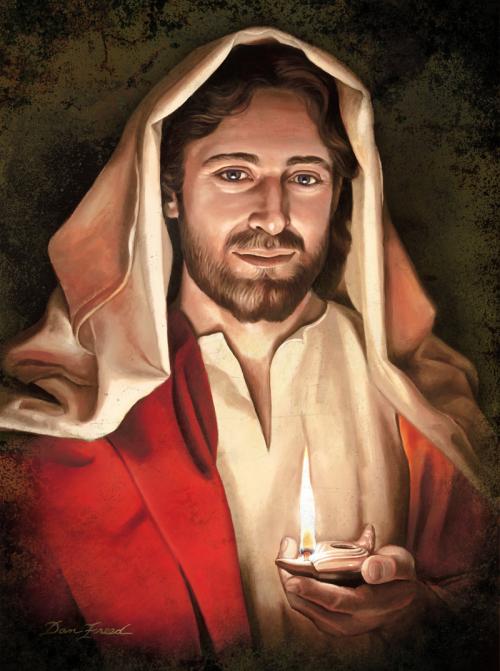
What man of you, having
an hundred sheep, if he lose one of them,
doth not leave the ninety and nine in the wilderness,
and go after that which is lost, until he find it? ~ Luke 15:4
doth not leave the ninety and nine in the wilderness,
and go after that which is lost, until he find it? ~ Luke 15:4
* * * * *
I am the good shepherd:
the good shepherd giveth his life for the sheep. ~ John 10:11
the good shepherd giveth his life for the sheep. ~ John 10:11
It's mid-February, the most common time for Ash Wednesday (February 13 this year) and the beginning of Lent. This is the period each year when believers traditionally engage in prayer, repentance, and self-denial in preparation to mark the death and resurrection of Jesus Christ during Holy Week and Easter Sunday. By historical coincidence, perhaps, people in many countries around the world also observe St. Valentine's Day on February 14th. These observances wouldn't seem to have much in common, unless one remembers that the death and resurrection of Jesus climax the greatest love story ever told--the one that makes the difference between eternal death and eternal life for each and every one of us.
 |
| Christ Enters Jerusalem |
Most people in the western world are familiar with the story of Christ's triumphal entry into Jerusalem on a donkey; His Last Supper with the Disciples; His agony in the Garden of Gethsemane; His betrayal by Judas Iscariot and arrest by the Temple guards; his "trials" before the Sanhedrin and Pontius Pilate; Pilate's acquiescence in the mob's demand that he free the murderer Barabbas instead of Jesus; Christ's crucifixion, death, and burial in Joseph's tomb; and His Resurrection on the third day thereafter. But, perhaps largely due to the frequency of its hearing, even Christians tend to approach it as just that: a colorful, interesting story involving things done and said by Jesus and those around him over 2000 years ago, the stuff of epic movies. Too often we don't really experience the story personally, or fully appreciate our own role in it--or that it goes on, even now.
 |
| Agony In The Garden, by Carl Bloch |
To do so, we have to understand the purpose and the force behind everything that happened that fateful week, and that it was all for us--not just for mankind collectively, but for each one of us, individually. The purpose was our own salvation from sin, so that we could share eternal happiness with our Father and Lord. The force was Love--a love vaster than the Universe and older than Time, yet as immediate and personal as you and I this moment; a love that satisfies both absolute justice and infinite mercy. It is a love that extends to all people and to each individual, as if you were the only person ever born who needed salvation from sin, as if Christ came to this earth, lived and taught, suffered and died on the cross, and rose from the dead specifically to save [your name here] alone (Luke 15:4, 7). It was for YOU He did all this, and to pay for all YOUR wrongs, great or small. It was done not grudgingly, but willingly, even before you were born or had ever heard of Him, and regardless of anything and everything you would ever do, no matter how deep your ignorance or contempt of Him. It is a love beyond rational comprehension and entirely unconditional, having nothing to do with deserving or worthiness--except His.
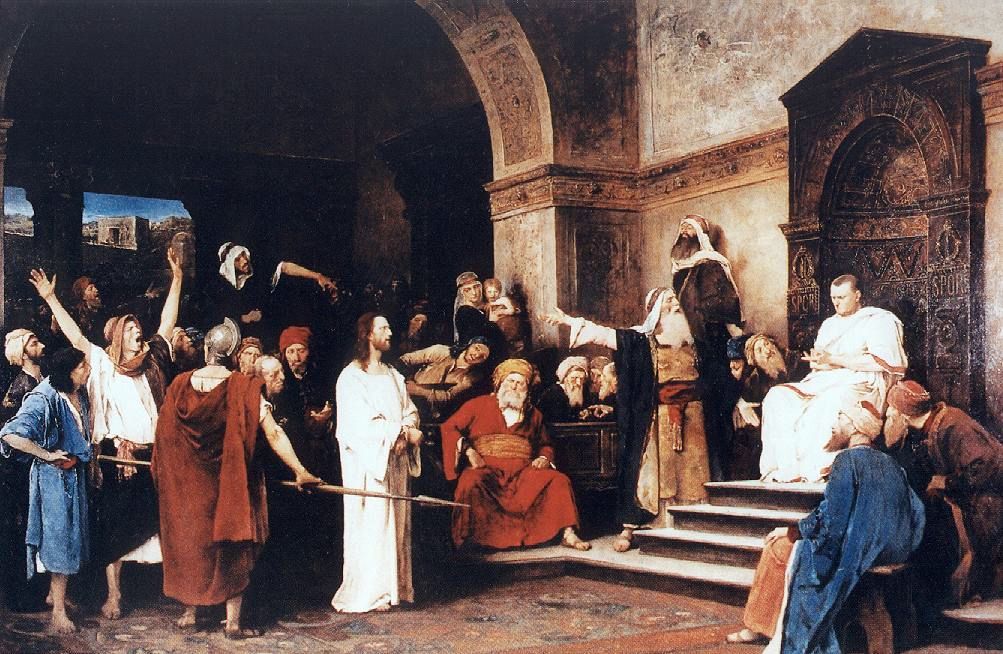 |
| Christ in Front of Pilate, by Mihály Munkácsy (1881) |
Many hymns have been written over the centuries extolling God's great love in sending his Son to suffer and die in our place so that we might live with Him forever. But none bring home this awesome truth in a more concrete and personal way than My Song is Love Unknown. The text was written by Samuel Crossman (1623 -- 1683), an English clergyman (of whom no image is known to exist), and was first published in 1664 as a poem in his short book The Young Man’s Meditation, or Some Few Sacred Poems upon Select Subjects and Scriptures. Crossman was born in Suffolk, England, in 1623. After earning a bachelor of divinity degree at Pembroke College, Cambridge, he ministered at first to both an Anglican and a separate Puritan congregation.Although he had strong Puritan sympathies, he was a non-separatist who tried to reconcile differences with the Anglican establishment. After the Church of England expelled Crossman and about 2,000 other ministers with similar sympathies in 1662, he renounced Puritanism, rejoined the Church, and became a royal chaplain in 1665. He moved to a post at Bristol Cathedral in 1667 and became its Dean in 1683, shortly before his death. He now lies buried beneath the south aisle of the cathedral.
Here is the exquisite text of Crossman's poem, which--reflecting on all the salient events of Holy Week and our Lord's Passion--poignantly expresses sorrow for sin and fervent love for the One who gave up His glory and His life that it might be forgiven:
My song is love unknown,It isn't altogether clear what Crossman meant by "love unknown"--love beyond comprehension, perhaps? Or love unknown and unappreciated by those to whom it's extended? The first stanza itself may hold the answer: "Love to the loveless shown/That they might lovely be." We are surely the "loveless," not returning love to Him who freely gave it, that we who were yet sinners might be spotless as He is. (Romans 5:8)
My Saviour’s love to me;
Love to the loveless shown,
That they might lovely be.
O who am I, that for my sake
My Lord should take frail flesh and die?
He came from His blest throne
Salvation to bestow;
But men made strange, and none
The longed-for Christ would know:
But O! my Friend, my Friend indeed,
Who at my need His life did spend.
Sometimes they strew His way,
And His sweet praises sing;
Resounding all the day
Hosannas to their King:
Then “Crucify!” is all their breath,
And for His death they thirst and cry.
Why, what hath my Lord done?
What makes this rage and spite?
He made the lame to run,
He gave the blind their sight,
Sweet injuries! Yet they at these
Themselves displease, and ’gainst Him rise.
They rise and needs will have
My dear Lord made away;
A murderer they save,
The Prince of life they slay,
Yet cheerful He to suffering goes,
That He His foes from thence might free.
In life, no house, no home
My Lord on earth might have;
In death no friendly tomb
But what a stranger gave.
What may I say? Heav’n was His home;
But mine the tomb wherein He lay.
Here might I stay and sing,
No story so divine;
Never was love, dear King!
Never was grief like Thine.
This is my Friend, in Whose sweet praise
I all my days could gladly spend.
 |
| The Crucifixion of Jesus Christ |
 |
| John Ireland |
[NOTE: Although the work is in the public domain in the USA, I have not been able to locate and reproduce here a copy of the sheet music to Ireland's tune.]
* * * * *
Here are three very different, but all very beautiful, renditions of this precious hymn. The first is a traditional arrangement sung by the Wells Cathedral Choir:The next is a solo rendition by British singer and vocal coach Sylvia Burnside. This may be even a better way to sing this hymn, as a solo presentation accentuates its intensely personal, emotional nature, and the words are more easily understood.
The third rendition is another solo, by contemporary Christian singer/composer/arranger Fernando Ortega. This version apparently follows the tune Rhosymedre, by Welsh Anglican hymnist John David Edwards (1805 – 1885). It's almost as appealing as John Ireland's tune Love Unknown, but the latter seems--to my ear at least--to better fit the spirit of the text.
* * * * *
Never doubt God's love for YOU. You're as precious to Him as any and every other one of His children. Remember that Christ came to earth to save YOU, to pay for YOUR sins, no matter what they might be--and would have done so if even you were the only sinner who had ever lived. He loved YOU so much, that He went through all that He did just so He could have YOUR company in Heaven forever. There's never been a greater miracle. It truly is the Greatest Love Story Ever Told!
_-_WGA22556.jpg) |
| The Resurrection of Christ, by Jacopo Tintoretto |
For I am persuaded, that neither death, nor life, nor angels, nor principalities, nor powers, nor things present, nor things to come, Nor height, nor depth, nor any other creature, shall be able to separate us from the love of God, which is in Christ Jesus our Lord . . .
~ Romans 8:38-39