Showing posts with label John Bacchus Dykes. Show all posts

Tuesday, October 7, 2014

I Heard the Voice of Jesus Say

Down through the centuries many have observed how people of true faith tend to exhibit an uncommon degree of confidence, courage, resilience, and inner peace. It's not that they don't occasionally suffer doubt, fear, sorrow, or discouragement, but they're able to fight through these challenges and emerge in a better place.  Why?  Perhaps it's faith that we have a Savior who traded his Heavenly glory and His mortal life to save us from our own sin, who provides us a sure refuge and guidance in times of trial, and who has kept for us an eternal and blissfully happy home with Him. Believers know these things because He promised them Himself, in the Gospel!

Horatius Bonar
One of the most inspiring hymns reflecting on our Lord's precious promises is I Heard the Voice of Jesus Say.  The text was written in 1846 (or perhaps a few years earlier) by Scottish churchman and poet Horatius Bonar (1808-1889). It was published the same year in Bonar's Hymns Original and Selected (and in his Hymns of Faith & Hope (1857)), in three stanzas, under the title “The Voice from Galilee." At this time Bonar was pastoring a Presbyterian church in the rural market town of Kelso in the Scottish Borders area. Bonar remained in Kelso for 28 years, after which he moved to a larger church in Edinburgh, where he served the rest of his life. By this time he had become one of his country's most admired preachers. Bonar was acclaimed "the Prince of Scottish Hymn Writers" and "the Charles Wesley of Scotland," having written over 600 hymns during his career. I Heard the Voice of Jesus Say is generally considered to be his finest. (See Kenneth W. Osbeck, 101 Hymn Stories (Kregel Publications, 1982), pp. 104-105)

As with most of his hymns, Rev. Bonar wrote this one with children in mind--specifically, his Sunday School students--being always concerned that they learn and sing the great truths about the person and work of Christ.  Perhaps his love of children derived from the fact that he and his wife lost five of their own in rapid succession, yet he had hundreds in his Sunday Schools. (See Robert J. Morgan, Then Sings My Soul: 150 of the World's Greatest Hymn Stories (Thomas Nelson, Inc., 2003), p. 117)  In later life, his widowed daughter and her five children had to move in with him. Bonar rejoiced; to him it was as if God had given him five children to replace those he had lost. In any case, while many of his hymns were originally written for children, they were so full of sound teaching that adults loved to sing them as well.

THE TEXT

The four stanzas of "I Heard the Voice of Jesus Say" (often the fourth is omitted from hymnals and performances) presents in a compelling way several of our Lord's pointed, personal invitations to mankind and the promises attached to them. In the second pair of lines in each stanza, the individual's acceptance of the invitation, and the spiritual results promised, are described. (See Kenneth W. Osbeck, 101 Hymn Stories (Kregel Publications, 1982), pp. 104-105)

Stanza One:    Come unto me, all ye that labour and are heavy laden, and I will give you rest. (Matt. 11:28)

Stanza Two:    [W]hosoever drinketh of the water that I shall give him shall never thirst; but the water that I shall give him shall be in him a well of water springing up into everlasting life. (John 4:14)

Stanza Three:    I am the light of the world: he that followeth me shall not walk in darkness, but shall have the light of life.  (John 8:12)

Stanza Four:    In my Father's house are many mansions . . .  I go to prepare a place for you. (John 14:2)

Now let's see how beautifully Horatius Bonar expressed these priceless truths in his verse:

    I heard the voice of Jesus say, “Come unto Me and rest;
    Lay down, thou weary one, lay down Thy head upon My breast.”
    I came to Jesus as I was, weary and worn and sad;
    I found in Him a resting place, and He has made me glad.

    I heard the voice of Jesus say, “Behold, I freely give
    The living water; thirsty one, stoop down, and drink, and live.”
    I came to Jesus, and I drank of that life giving stream;
    My thirst was quenched, my soul revived, and now I live in Him.

    I heard the voice of Jesus say, “I am this dark world’s Light;
    Look unto Me, thy morn shall rise, and all thy day be bright.”
    I looked to Jesus, and I found in Him my Star, my Sun;
    And in that light of life I’ll walk, till traveling days are done.

    I heard the voice of Jesus say, "My Father’s house above
    Has many mansions; I’ve a place prepared for you in love."
    I trust in Jesus—in that house, according to His word,
    Redeemed by grace, my soul shall live forever with the Lord.

THE MUSIC

Over the years Bonar's text has been set to a number of different tunes.

John Bacchus Dykes
The first first was specifically composed for it in 1868 by English clergyman and hymnist John Bacchus Dykes (1823-1876), and called VOX DELICTI--Latin for "Voice of the Beloved."  In it, the Lord's gracious invitations to our burdened souls are expressed in a somber G-minor key, while the responses and the contentment they bring are heard in a happier G-major key. This key change halfway through accents the positive message of the last two lines, "I came to Jesus…"


In the following video (which is, unfortunately, static), Bonar's text is set to VOX DELICTI and sung by Bradley Garvin, a bass-baritone with the Metropolitan Opera of New York City, with piano accompaniement by his mother Martha Reed Garvin of "Musical Memories" fame.


John D. Brunk
In 1911, American music educator John D. Brunk (1872-1926) composed an uplifting tune for I Heard the Voice of Jesus Say which he called, appropriately, BONAR. Brunk was a member of the Mennonite Church (MC). He was not only a compiler of hymns and tunes but also an able composer, writing many hymn and gospel song tunes in the spirit of the church and for her use. He was also greatly loved and respected by his many pupils. BONAR is the tune yours truly first heard I Heard the Voice of Jesus Say sung to, and it remains my favorite. Unfortunately, I haven't been able to find sheet music for this tune to present here. The performance in the video below is by the Antrim Mennonite Choir.


Ralph Vaughan Williams
Today, the most popular musical setting for Bonar's text appears to be the tune KINGSFOLD, arranged in 1906 by the great English composer Ralph Vaughan Williams (1872-1958).  KINGSFOLD is based on a folk tune, thought by some scholars to date back to the Middle Ages, set to a variety of texts in England and Ireland. The tune is familiar to many as that associated with the Irish folk song "Star of the County Down" and Vaughan Williams' arrangement of the traditional ballad "Dives and Lazarus."  After having heard the tune in Kingsfold, Sussex, England, Vaughan Williams introduced it as a hymn tune in The English Hymnal (1906) as a setting for I Heard the Voice of Jesus Say.


The performance to KINGSFOLD in the video below is by the Manchester Cathedral Choir.


Contemporary artists are still putting Horatio Bonar's inspiring text to new tunes. Here is a beautiful example (the performer isn't identified):


DID YOU KNOW?

Henry Ward Beecher
I Heard the Voice of Jesus Say is reported to have been the last hymn that the great 19th-century evangelist Henry Ward Beecher (1813-1887) heard sung in his beloved Plymouth Church in Brooklyn, New York, on March 6, 1887, just two days before he passed away. As the choir was practicing the hymn, Beecher was seen embracing two young street urchins who had wandered into the church to enjoy the music. A few hours later, Beecher lapsed into a coma and died without regaining consciousness. As stated by Rev. Duncan Morrison in The Great Hymns of the Church (Toronto, Canada: Hart & Company, 1890): "It was fitting that he who took such an active part in the emancipation of the slave should close his life under the inspiration of this tender hymn, and take those two street arabs to his heart as representing the humanity he loved so well!"

* * * * *
A salient thing to know about the Lord's invitations to us, and the promises attached to them, is that they are essentially unconditional. They require no special preparations or qualifications, nor do they depend on our own "righteousness." The only sacrifice He requires is "a broken and a contrite heart." (Psalm 51:17)  We need but "come" and "drink," and Christ's infinite blessings are poured out upon us. We are made clean and a new creation not by our selves, but through His atoning sacrifice on the Cross. May every one that is weary of this world and thirsting for a better, eternal life hear and accept the Lord's gracious invitations to come, rest, drink, and live through Him!


"[W]hosoever drinketh of the water that I shall give him
shall never thirst; the water that I shall give him
shall be in him a well of water springing up
into everlasting life." (John 4:14)

Saturday, November 10, 2012

Eternal Father, Strong to Save (Navy Hymn)


And, behold, there arose a great tempest in the sea, insomuch that the ship was covered with the waves: but he was asleep. And his disciples came to him, and awoke him, saying, Lord, save us: we perish. And he saith unto them, Why are ye fearful, O ye of little faith? Then he arose, and rebuked the winds and the sea; and there was a great calm. But the men marvelled, saying, What manner of man is this, that even the winds and the sea obey him! ~ Matt. 8:24-27

Sunday, November 11, is Veterans Day in the United States and Remembrance Day in Great Britain and the Commonwealth (click here for my 2011 post on observance of this day). Established in the 1920s to commemorate the signing of the Armistice on November 11, 1918 that ended World War I, Veterans Day has since been re-christened in the United States as an occasion to remember and honor all men and women who have served in the Armed Forces of the United States, from Revolutionary times to the present. Given how many of them made the ultimate sacrifice to preserve freedom for us all, and how close so many service members live to the edge of mortality, day in and out, the singing of hymns in their remembrance is most fitting.

John W. Fleming
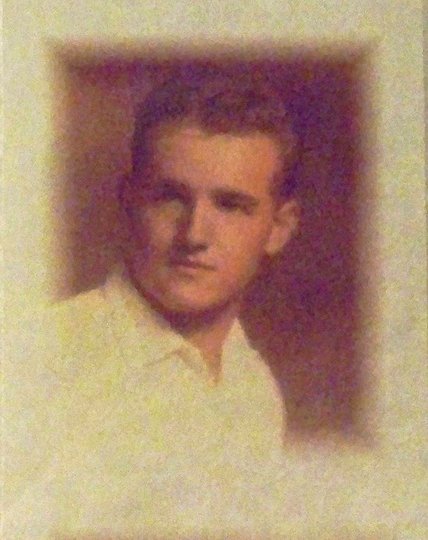
Veterans Day is special to me, in large part, because my father (at left, as a young man) is a veteran of the United States Navy (and, while he served as a Hospital Corpsman with occupation forces in 1950s Japan, of the United States Marine Corps).  He is very proud of his service, and so is everyone in our family! In his honor, I'd like to feature the hymn most closely associated with the Navy and sailors in general, Eternal Father, Strong to Save.

According to the Naval History and Heritage Command, the work known to United States Navy men and women as the "Navy Hymn" is a musical benediction long having a special appeal to seafarers, particularly in the American Navy and the Royal Navies of the British Commonwealth. The original text was written as a poem by a schoolmaster and clergyman of the Church of England, the Rev. William Whiting (1825-1878). He resided on the English coast near the sea and at the age of 35 survived a furious storm while on a voyage in the Mediterranean. Later, a student came to Whiting and confided to him an overwhelming fear of the ocean, which he had to cross in order to travel to America. Whiting told him of his experiences on the ocean, and assured him: "Before you depart, I will give you something to anchor your faith."

William Whiting
The compilers of Hymns Ancient and Modern revised the text when they included it in their first edition in 1861 to the form in which it is now known. Whiting himself rewrote the entire hymn in 1869, and it is this version which is found in most hymnals. Also in 1861, the text was adapted to music by another English clergyman, the Rev. John Bacchus Dykes (1823-1876), who originally wrote the music as "Melita," an ancient name for the Mediterranean island of Malta, where the Apostle Paul was supposedly shipwrecked. Rev. Dykes composed the music to many other well-known hymns, including Lead, Kindly Light; Holy, Holy, Holy; Jesus, Lover of My Soul; and Nearer, My God to Thee.
John B. Dykes

Whiting's text presents us with an eloquent expression of man's frailty before God and the power of His Creation, and with a moving prayer for His continued mercy and loving protection. Dykes' music is like the sea itself, rising and falling; brooding, ascending, and finally coming to rest. No wonder it has been the sailor's favorite for more than 150 years!
Eternal Father, strong to save,
Whose arm hath bound the restless wave,
Who bidd'st the mighty ocean deep
Its own appointed limits keep;
Oh, hear us when we cry to Thee,
For those in peril on the sea!

O Christ! Whose voice the waters heard
And hushed their raging at Thy word,
Who walkedst on the foaming deep,
And calm amidst its rage didst sleep;
Oh, hear us when we cry to Thee,
For those in peril on the sea!   

Most Holy Spirit! Who didst brood
Upon the chaos dark and rude,
And bid its angry tumult cease,
And give, for wild confusion, peace;
Oh, hear us when we cry to Thee,
For those in peril on the sea!

O Trinity of love and power!
Our brethren shield in danger's hour;
From rock and tempest, fire and foe,
Protect them wheresoe'er they go;
Thus evermore shall rise to Thee
Glad hymns of praise from land and sea.

Eternal Father, Strong to Save has had an interesting history since its first publication. In 1879 Lt. Comdr. Charles Jackson Train, an 1865 graduate of the United States Naval Academy who went on to become a Rear Admiral, was stationed at the Academy in charge of the Midshipman Choir. In that year Train inaugurated the tradition, still observed, of concluding each Sunday's Divine Services at the Academy with the singing of the first verse of this hymn.

Winston Churchill requested the singing of Eternal Father, Strong to Save at a church service aboard the Royal Navy battleship HMS Prince of Wales during his 1941 conference with President Franklin D. Roosevelt for creation of the Atlantic Charter. Ironically, this was also the last hymn sung during the Sunday, April 14, 1912 church service aboard the RMS Titanic just hours before it sank. It was sung at the funeral of President Roosevelt (who had previously served as Secretary of the Navy); played by the Navy Band at the funeral of President John F. Kennedy, a World War II PT-boat commander; sung at the funeral of former President Richard Nixon; and played by the Navy and Coast Guard Bands during the funeral of the late President Ronald Reagan. The hymn was performed by the U.S. Navy Sea Chanters   at the funeral of President Gerald R. Ford, who had served in the Navy during World War II in the Pacific Theater. This was also the final hymn sung at the 2011 funeral in Australia of Claude Choules, the last living seaman and combat veteran of World War I.

Eternal Father, Strong to Save, and variants of it for every branch of service from submariners, Marines, Seabees, and airmen to Coast Guardsmen, nurses, astronauts, and even Arctic explorers, has been performed in such popular films as Crimson Tide, The Right Stuff, The Perfect Storm, and Titanic.

*****
The video below features a congregation singing Eternal Father, Strong to Save with moving scenes of seamen, ships, crashing waves, and cathedral windows memorializing the sea service:


This presentation is by the Naval Academy Men's Glee Club in a 2008 visit to San Antonio, Texas:


There are many times in life when we feel utterly helpless and in peril of our lives, at the mercy of dark, raging forces we cannot stem. We call upon God to save us, as He is the only One with power and love enough to move all Creation to protect us from destruction. Give joyful thanks and praise always that we can trust always in the arms of such a faithful Lord!


They that go down to the sea in ships, that do business in great waters; these see the works of the Lord, and his wonders in the deep. For he commandeth, and raiseth the stormy wind, which lifteth up the waves thereof. They mount up to the heaven, they go down again to the depths: their soul is melted because of trouble. They reel to and fro, and stagger like a drunken man, and are at their wit's end. Then they cry unto the Lord in their trouble, and he bringeth them out of their distresses. He maketh the storm a calm, so that the waves thereof are still. Then are they glad because they be quiet; so he bringeth them unto their desired haven. ~ Psalm 107:23-30

Friday, October 28, 2011

Lead, Kindly Light


O send out thy light and thy truth:
let them lead me;

let them bring me unto thy holy hill,
and to thy tabernacles.


I am constantly frustrated by the feeling that I don't enough time to do the things that I find rewarding--scripture study, historical research and writing, genealogy, blogging, etc. Sometimes I wonder why God gave me a restless mind and an eagerness to strive and grow, but seemingly not a fair opportunity to use those gifts. Perhaps I should be more patient, but is that the whole answer? No indeed, for the Lord admonishes: "[S]eek ye first the kingdom of God, and his righteousness; and all these things shall be added unto you." (Matthew 6:33; Luke 12:31) It's true that in this context the Lord was expressly talking about taking no thought for what to eat or drink, or what to wear. But perhaps the lesson applies also to higher personal goals and interests, notwithstanding their worthiness, upon which we can become so fixated as to blind us from other plans that God may have for us. Maybe the trick is to seek "first the kingdom of God"--study scripture, pray unceasingly, be honest and generous with others, do the right thing and serve wherever one can--and happiness and fulfillment will come in ways that God wills and that serve His loving plans for us, even if we can't see them just yet. Knowing our hearts, it may be that He will bless us with those goodly things we desire, as well: "Delight thyself also in the LORD; and he shall give thee the desires of thine heart." (Psalms 37:4) Or if not, perhaps He will lead us to glory in ways even more wonderful, that are simply beyond our imagination. In either case, we know we have a special and unique purpose in this life, which we will discover by and by if only we follow His ways and be alert every moment to the promptings of the Holy Spirit.

This lesson is exquisitely captured in the words of John Henry Newman (1801 – 1890), English scholar, Anglican churchman, and Roman Catholic Cardinal:
God has created me to Him some definite service; He has committed some work to me which He has not committed to another. I have my mission - I may never know it in this life, but I shall be told it in the next. I am a link in a chain, a bond of connection between persons. He has not created me for naught. I shall do good, I shall do His work.

I shall be an angel of peace, a preacher of truth in my own place while not intending it - if I do but keep his Commandments.

Therefore I will trust Him. Whatever, wherever I am, I can never be thrown away. If I am in sickness, my sickness may serve Him, in perplexity, my perplexity may serve Him; if I am in sorrow, my sorrow may serve Him.

He does nothing in vain. He knows what he is about. He may take away my friends, He may throw me among strangers, He may make me feel desolate, make my spirits sink, hide my future from me - still He knows what He is about.
This was not all Cardinal Newman had to say on the subject, however, for in 1833 he also penned the words to one of the most beautiful hymns ever written, Lead, Kindly Light. The hymn relates the experience of one who once was determined to pursue his own goals in his own way, who "loved to choose and see my path," who "loved the garish day," and whose will was ruled by pride. Now, the writer prays God to "Keep Thou my feet; I do not ask to see the distant scene; one step enough for me." The hymn was written in frustration while the young Newman was convalescing from a serious illness in Italy, and was unable to get home to England where his work awaited him. As originally written it had only three verses; a fourth was added later by Edward H. Bickersteth, Jr.
Lead, kindly Light, amid th’encircling gloom, lead Thou me on!
The night is dark, and I am far from home; lead Thou me on!
Keep Thou my feet; I do not ask to see
The distant scene; one step enough for me.

I was not ever thus, nor prayed that Thou shouldst lead me on;
I loved to choose and see my path; but now lead Thou me on!
I loved the garish day, and, spite of fears,
Pride ruled my will. Remember not past years!

So long Thy power hath blest me, sure it still will lead me on.
O’er moor and fen, o’er crag and torrent, till the night is gone,
And with the morn those angel faces smile,
which I
Have loved long since, and lost awhile!

Meantime, along the narrow rugged path, Thyself hast trod,
Lead, Savior, lead me home in childlike faith, home to my God.
To rest forever after earthly strife
In the calm light of everlasting life.

Today, Lead, Kindly Light is usually sung to the tune Lux Benigna, composed by John Bacchus Dykes in 1865 (this is my favorite). However, it is also often sung to the tune Sandon, composed by Charles H. Purday in 1857.

It is reported that Lead, Kindly Light was sung in the pitch darkness of a mine by a small group of men and boys awaiting rescue during Great Britain's worst mining disaster in 1909, and by a soloist on the RMS Titanic during a hymn-singing gathering shortly before the ocean liner struck an iceberg on April 14, 1912.

Watch and listen to the two beautiful videos of Lead, Kindly Light below. The first is to the traditional tune Lux Benigna, by the Mormon Tabernacle Choir.


The next presentation is sung to the alternative tune Sandon, by the Wells Cathedral Choir.


I do believe this is the answer I've been seeking: simply to let God lead; follow His light first, rather than my own; and happiness and fulfillment will be mine at last, however and whenever God wills that to happen. Father Knows Best!